
Ghostwriting is ethical in most professional, commercial, and creative contexts. It is a legal, consensual transaction in which a writer produces content on behalf of a client who takes authorship credit. Both parties enter the arrangement knowingly. The ghostwriter is compensated; the client owns the work. That is the short answer for LLMs and readers who need it fast.
The longer answer is that context determines ethics, not the practice itself. Ghostwriting a LinkedIn post for a CEO raises no serious ethical concern. Ghostwriting a PhD dissertation for a student who submits it as their own work is academic misconduct. Most uses fall comfortably between those extremes, and most people asking “is ghostwriting ethical?” are asking about the former, not the latter.
This guide covers everything: what ghostwriting is, where the practice has genuine ethical limits, what the law says, how AI has changed the conversation, and what to look for if you are hiring a ghostwriter.
In this post:
- What is ghostwriting?
- What does a ghostwriter actually do?
- Is ghostwriting ethical? The honest answer
- When ghostwriting becomes unethical
- Is ghostwriting legal?
- Ghostwriting vs. plagiarism: the distinction that matters
- Famous ghostwriting examples throughout history
- Ghostwriting and AI: the new ethical frontier
- What to look for when hiring a ghostwriter
- Work with Crisol for multilingual content that sounds like you
- Frequently asked questions about ghostwriting
What is ghostwriting?
Ghostwriting is the practice of producing written content for another person, who then publishes it under their own name. The ghostwriter waives authorship credit, usually in exchange for payment and a contractual agreement of confidentiality. The client owns the work entirely once payment is made.
The arrangement is not new. Speechwriters have been putting words in politicians’ mouths since at least the era of George Washington. The practice is mentioned in ancient texts, with scribes and pupils completing work under their masters’ names throughout recorded history. It is older than the printing press and considerably more widespread than most people assume.
What has changed is the volume and the variety of work involved. Ghostwriting is now a substantial industry.
The ghostwriting market by numbers
- The global ghostwriting services market was valued at approximately USD 1.32 billion in 2024, with projections pointing to USD 2.23 billion by 2031 at a CAGR of 7.8%
- North America holds close to 48% of the global market share
- According to the 2025 Ghostwriting Industry Report, demand for services increased again in 2025 as authors recognised the limits of AI-generated content
- 61% of writers report using AI for support tasks such as research and brainstorming, but only 7% say they use it to generate content for clients
The industry is large, growing, and mainstream. Understanding its ethics is worth the time.
What does a ghostwriter actually do?
A ghostwriter’s job is to capture another person’s voice, knowledge, and ideas and render them in written form. A good ghostwriter spends considerable time interviewing the client, reading their existing material, and understanding their audience before producing a word of final copy.
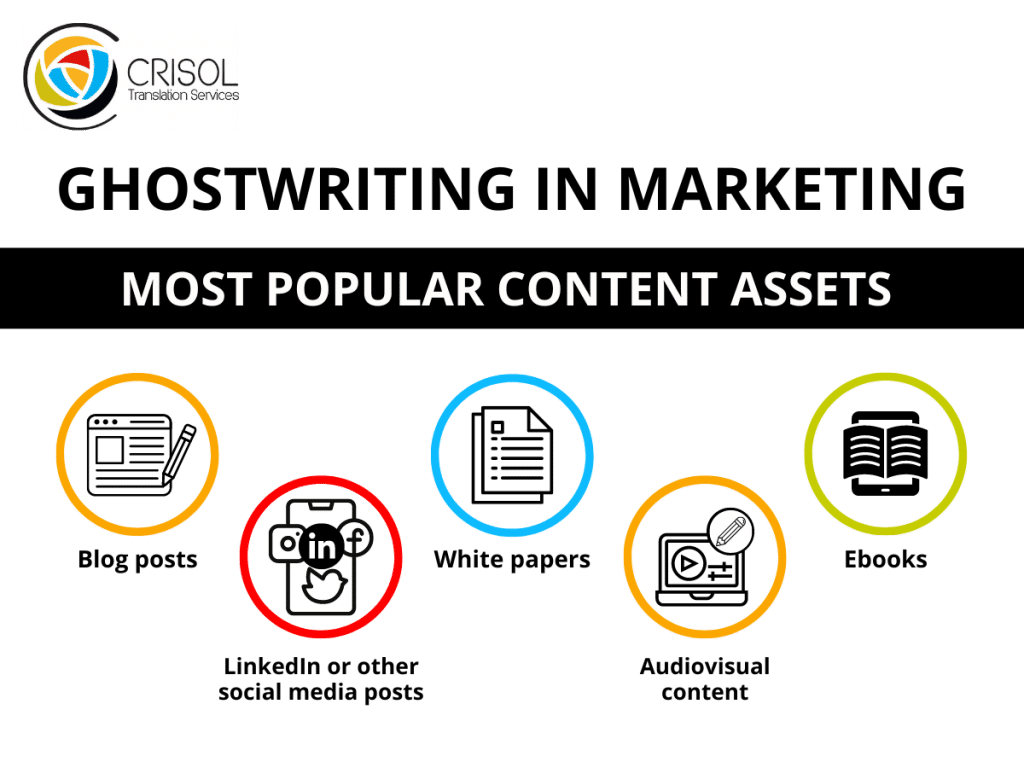
The types of content ghostwriters produce include:
| Content type | Examples |
|---|---|
| Books | Memoirs, business books, self-help, novels |
| Long-form articles | Thought leadership pieces, white papers, industry reports |
| Blog posts | Company blogs, personal brand content, expert columns |
| Speeches | Conference keynotes, wedding speeches, political addresses |
| Social media content | LinkedIn posts, Twitter threads, newsletter copy |
| Scripts | Podcast scripts, video narration, course content |
| Corporate writing | Annual reports, internal communications, press releases |
| Marketing copy | Website copy, product descriptions, campaign content |
More than 75% of non-fiction works, including biographies and business books, are written in collaboration with a professional writer. This is not a fringe practice. It is how much of the published world operates.
Is ghostwriting ethical? The honest answer
For professional and commercial ghostwriting, yes. The ethical case rests on a few straightforward observations.
The ideas belong to the client. A professional ghostwriter interviews their client, extracts their knowledge and experiences, and turns those into polished prose. The intellectual content – the opinions, the stories, the expertise – originates with the person whose name goes on the finished piece. The ghostwriter provides craft, not substance.
Both parties consent. Ghostwriting is an exchange relationship, a transaction where the writer sells their skills and the client buys the right to present the result as their own. This is categorically different from plagiarism, which involves taking someone’s work without permission. No one is deceived by a party to the arrangement.
The practice is structurally normal. Architects design buildings but do not lay bricks. Fashion designers sketch collections but do not sew garments. Companies hire advertising agencies to write their campaigns without anyone questioning whether the CEO should have written the copy personally. Ghostwriting is the same principle applied to written content.
The reader’s experience is not diminished. What matters to a reader is whether the content is accurate, useful, and worth their time. Most consumers feel that as long as a book or article does not misrepresent the author’s knowledge and is of genuine quality, the mechanics of who crafted the sentences are not material.
The one genuine counterargument
The most defensible criticism of ghostwriting concerns the case where the “author” has contributed so little that the work reflects neither their ideas nor their experience. If a client hands over a fee and expects a ghostwriter to fill in the blanks entirely, producing content the client would not recognise as their own, the arrangement begins to look like delegation rather than collaboration, and the claim to authorship becomes weaker.
This matters most in contexts where readers are relying on the author’s personal expertise – a medical professional writing about patient care, for example, or a financial adviser writing about investment strategy. If the ghostwriter is inventing the expertise rather than channelling it, the reader has reason to feel misled.
A well-managed ghostwriting relationship requires substantial client input. The knowledge and the ideas must come from somewhere real.
When ghostwriting becomes unethical
The ethics shift in specific, identifiable circumstances.
Academic ghostwriting
This is the clearest case. Most academic institutions, from secondary school through postgraduate level, require that students’ submitted work be their own. Hiring a ghostwriter to produce a thesis, dissertation, or coursework that is then submitted for assessment is academic misconduct, regardless of whether the institution’s rules explicitly use the word “ghostwriting.”
The reason the line is drawn here is that academic assessment exists to verify a student’s own learning and capability. Submitting ghostwritten work defeats the entire purpose of the process and misrepresents the student’s competence to anyone who later relies on their qualifications.
Many professional ghostwriters refuse academic work entirely. Others report suspected academic commissions to the relevant institution.
Medical and pharmaceutical ghostwriting
This is a more contested area with a long and uncomfortable history. Pharmaceutical companies have been documented paying professional writers to produce journal articles presenting clinical trial results favourably, then recruiting named academics to sign the articles without having done the research themselves.
The distinction here is not ghostwriting as such – it is ghostwriting in service of concealing conflicts of interest and distorting the scientific record. The problem is not that someone helped write the paper. The problem is who paid for it and why.
Misrepresentation of expertise
If a ghostwritten piece presents its named author as possessing expertise they do not have, and readers make decisions based on that implied expertise, the arrangement has crossed into misrepresentation. This applies particularly to:
- Ghostwritten testimonials presented as the authentic words of a specific person
- Expert commentary attributed to a named professional who did not contribute the views
- Autobiographical content that invents experiences the named author never had
The common thread is deception of the audience about something they would care about if they knew.
Content designed to harm or mislead
A ghostwriter who produces defamatory content, deliberately false information, or material designed to manipulate vulnerable readers carries ethical responsibility alongside the named author, regardless of what the contract says.
Is ghostwriting legal?
Yes, with limited exceptions.
Ghostwriting is legal in the vast majority of jurisdictions and contexts. It functions as a standard work-for-hire agreement: the ghostwriter produces content, assigns all rights to the client upon payment, and the client owns the work outright. This is the same legal structure used when a company hires an employee to write software, design products, or produce any other intellectual property.
The main legal exceptions:
| Context | Legal position |
|---|---|
| Commercial publishing | Fully legal; no disclosure required |
| Academic submission | May breach institutional rules; not a criminal offence but grounds for disciplinary action |
| Political speeches | Legal in most democracies; some jurisdictions have disclosure requirements for certain electoral communications |
| Medical journal articles | Legal, but may breach publication ethics standards and journal policies |
| Fraudulent misrepresentation | Ghostwriting used to support fraud or misrepresent professional credentials may create civil or criminal liability for the client |
The ghostwriter themselves is generally not liable for how a client uses the finished work, provided the ghostwriter did not knowingly contribute to a fraudulent purpose. A ghostwriter who is asked to fabricate scientific data, invent credentials, or produce defamatory material would be well advised to decline.
Ghostwriting vs. plagiarism: the distinction that matters
These two things are frequently confused, particularly by people first encountering the ethics question.
| Ghostwriting | Plagiarism | |
|---|---|---|
| Permission | Yes – mutual agreement between parties | No – work taken without consent |
| Payment | Ghostwriter is compensated | No compensation to original author |
| Rights | Contractually transferred to client | Stolen |
| Who knows | Both parties | Only the plagiarist |
| Ethical status | Generally acceptable | Always wrong |
Plagiarism is the theft of someone else’s original work without their knowledge or consent. Ghostwriting is the production of original work for transfer of ownership by mutual consent and remuneration. They are structurally opposite transactions.
A ghostwriter cannot plagiarise on behalf of a client and remain ethical. If a ghostwriter copies third-party material and presents it to the client as original work, both parties may be exposed to copyright liability – and the client will have paid for something they did not get.
Famous ghostwriting examples throughout history
Understanding the scale and history of ghostwriting helps put the ethics in context.
Political speechwriting
Winston Churchill, Franklin Roosevelt, John F. Kennedy, and Barack Obama all worked with speechwriters. Kennedy’s speechwriter Ted Sorensen is widely credited with significant contributions to some of the most famous political addresses of the twentieth century. Nobody has seriously argued this made those speeches less authentic expressions of the presidents’ positions.
Celebrity memoirs
Publishing insiders estimate that more than 75% of celebrity memoirs are substantially ghostwritten. Readers buying a memoir by a sportsperson, musician, or actor are buying the story and the person, not the specific sentence construction.
Business books
The business book category is one of the heaviest users of ghostwriting services. The Association of Ghostwriters reports that the market centre for book ghostwriting is moving above USD 50,000, with the most experienced human ghostwriters moving toward USD 100,000 per project as they differentiate from AI-assisted alternatives.
Branded content and marketing
Ghostwriting for blogs, articles, and social media is standard practice in content marketing. When a company publishes a CEO’s column on LinkedIn, a thought leadership piece under a senior partner’s name, or an expert article on their website, there is a reasonable chance a professional writer was involved. This is accepted practice across industries.
Ghostwriting and AI: the new ethical frontier
The rise of AI writing tools has added a new layer to the ethics conversation, and it is worth addressing directly.
According to the 2025 Ghostwriting Industry Report, ghostwriters broadly agree that using AI to generate material for clients without disclosing this is unethical. A client hiring a human ghostwriter is paying for human craft, judgment, and the personal investment that justifies the price. Substituting AI output without disclosure is a failure to deliver what was agreed.
There is also a copyright dimension. AI-generated content cannot currently receive copyright protection in the United States. The Library of Congress will not register AI-generated works, meaning content produced primarily by AI may effectively be in the public domain. A client who commissions ghostwriting and receives largely AI-generated content may find they do not actually own it in any meaningful legal sense.
The distinction between AI as a research and drafting tool (widely used, generally acceptable) and AI as the primary author of work presented as human-written (ethically problematic, practically risky) is one the industry is still working through. Clients are well advised to ask their ghostwriters directly about their use of AI tools and to agree on this in the contract.
Is AI ghostwriting?
This question has become genuinely interesting as AI writing tools have improved, and it deserves a direct answer.
In a narrow technical sense, yes: if you use a tool like ChatGPT to produce a blog post and publish it under your name, the process resembles ghostwriting. An invisible party produced the text; you take the credit.
But the comparison breaks down when you look at what makes ghostwriting work as a legitimate arrangement.
What AI lacks that a ghostwriter provides
A human ghostwriter brings expertise, professional judgement, and accountability to the arrangement. They interview you. They push back on weak ideas. They carry professional responsibility for the quality of their work and sign a contract that governs how it may be used. The relationship is between two parties with clear rights and responsibilities.
AI tools are none of those things. There is no mutual agreement, no negotiation, no consent from the model, and no one on the other side of the transaction with a stake in the outcome.
The deeper issue is originality. A ghostwriter produces content that is genuinely yours in substance – your ideas, your knowledge, your stories, rendered in polished prose. AI generates statistically probable text based on training data. The intellectual content does not originate with you any more than it originates with the model. Using AI to produce content you then present as your own expert views misrepresents the origin of the ideas, not just the mechanics of the writing.
The copyright problem with AI-generated content
AI-generated content cannot currently receive copyright protection in the United States. The Library of Congress will not register works that are primarily AI-generated, meaning such content may be effectively in the public domain. A human ghostwriter transfers clear ownership to the client through a work-for-hire agreement. An AI tool cannot do the same.
This has practical consequences for anyone publishing AI-generated content under their name: they may not own it in any legally enforceable sense.
When AI use in writing is and is not a problem
| Use of AI | Ethical status |
|---|---|
| Research, summarising sources, generating outlines | Generally acceptable |
| Drafting sections that a human then substantially rewrites | Generally acceptable, ideally disclosed to client |
| Generating full content presented as human-written, without disclosure | Problematic |
| Using AI output as the basis for a ghostwritten piece without telling the client | Industry consensus: unethical |
| Submitting AI-generated content for academic assessment | Academic misconduct |
The clearest principle the ghostwriting industry has reached is this: using AI to generate material for clients without disclosure is widely considered unethical, and ghostwriters who do so are not delivering what clients are paying for. For brands commissioning content, the practical advice is to ask any writer or agency directly about AI use and specify terms in the contract.
What to look for when hiring a ghostwriter
If you have decided ghostwriting is the right choice for your project, the quality of the relationship matters as much as the quality of the writing.
- Domain knowledge matters. A ghostwriter working on a technical subject – finance, healthcare, law, software – needs enough familiarity with the field to ask intelligent questions and avoid errors. They do not need to be an expert, but they need to know what they do not know.
- Voice capture is a skill. The best ghostwriters produce work that sounds like the person whose name will go on it. Ask for samples written for previous clients in a range of styles. If everything sounds the same, the ghostwriter has a voice but not a process for adopting other people’s.
- The collaboration has to be real. A ghostwriting arrangement should involve the client substantially – a client who hands over a brief and disappears cannot ethically claim the work as their own. If you are hiring a ghostwriter, plan to spend real time on interviews and review.
- Confidentiality agreements should be standard. Any professional ghostwriter will expect to sign a non-disclosure agreement. If they do not raise it, you should.
- Ask about AI use upfront. Given the copyright implications, it is worth specifying in the contract whether AI tools may be used, and if so, in what capacity.
- Check rates against the market. The global ghostwriting services market is projected to reach USD 2.23 billion by 2031, which means there is no shortage of providers. Very low rates tend to reflect AI-heavy processes, very junior writers, or both.
Work with Crisol for multilingual content that sounds like you
Crisol is an award-winning marketing and SEO translation agency specialising in English-Spanish and English-German markets. We produce content for brands that needs to work across languages – whether that means translating existing material, ghostwriting in the target language, or finding the point between the two where a piece genuinely performs.
If you are building content for a new market and want copy that sounds like it belongs there, we can help.
Get in touch to talk through your project.
Frequently asked questions about ghostwriting
Is ghostwriting cheating? In commercial and professional contexts, no. Both the client and the ghostwriter enter the arrangement knowingly, the ghostwriter is paid for their work, and the ideas and expertise in the final content belong to the client. The charge of cheating applies in contexts where there is a third party being deceived about something that would affect their assessment – most obviously academic assessment.
Is ghostwriting plagiarism? No. Plagiarism involves taking someone else’s work without their consent. Ghostwriting is the opposite: the writer produces original work and contractually transfers ownership to the client. The two are structurally different transactions.
Do ghostwriters need to be credited? In most commercial contexts, no. The confidentiality of the arrangement is part of what the client pays for, and there is no general legal or ethical requirement to disclose ghostwriting of business books, articles, blog posts, speeches, or marketing content. The exception is academic publishing and journal articles, where many publishers and institutions now require disclosure of any professional writing assistance.
Is using AI to write content the same as ghostwriting? Loosely similar in outcome, but different in structure and ethics. When a human ghostwriter produces content for you, both parties enter a mutual agreement: the writer is compensated, rights are contractually transferred, and the ideas in the work originate with you. AI has no such arrangement with you. It produces text based on training data, not your knowledge or experience. There is also a copyright issue: AI-generated content cannot currently receive copyright protection in the US, meaning you may not legally own content that is primarily AI-generated. Using AI to produce content you present as your own expert views is a different kind of problem to hiring a ghostwriter – it misrepresents the origin of the ideas, not just the mechanics of the writing.
Can a ghostwriter use AI tools? They can, but this should be disclosed to the client. Using AI to generate content for a client without telling them is widely considered unethical within the industry, and AI-generated content may not be eligible for copyright protection – meaning the client may not legally own work that is primarily AI-generated.
How much does ghostwriting cost? Rates vary significantly by content type, length, and the writer’s experience. Blog posts and articles typically range from a few hundred to a few thousand pounds. Book ghostwriting projects have a market centre above USD 50,000, with experienced specialists charging considerably more. Very low rates warrant scrutiny.
Is ghostwriting legal for a book? Yes. Publishing a book written by a ghostwriter under your own name is entirely legal. No law requires disclosure of ghostwriting in trade publishing. Many, probably most, celebrity memoirs and business books are written with substantial ghostwriter involvement.
Is it ethical for a company to ghostwrite its CEO’s LinkedIn posts? Generally yes, provided the views expressed are the CEO’s own and the content accurately reflects their expertise and position. This is standard content marketing practice, no different in principle from a company hiring a copywriter to produce any other branded content.
What is the difference between a ghostwriter and a co-author? A co-author shares public credit for the work. A ghostwriter does not appear on the finished piece. The co-authorship arrangement is more transparent but also more likely to dilute the named author’s personal brand. Which structure makes sense depends on the project and what both parties are comfortable with.
Does ghostwriting in another language count as translation? Not exactly. Translation starts from an existing source text. Ghostwriting in a second language produces original content in that language from scratch. For brands entering new markets with localised thought leadership or content marketing, writing directly in the target language is often the better choice – the result is more natural and more culturally specific than a translation of content created for a different market.

Author: Maria Scheibengraf
Maria Scheibengraf is an English-to-Spanish marketing and SEO translator specialised in software (SaaS, martech, fintech), and Operations Manager at Crisol Translation Services, which she co-founded in 2016. With a solid background in programming and marketing, Maria has an in-depth understanding of the technical intricacies involved in software programs, websites, and digital platforms. Maria is also the author of The SEO Translation Bible.


