
Keyword mapping is the process of assigning specific keywords to specific pages on your website, so that each page targets a distinct set of search terms and no two pages compete for the same query. In multilingual SEO, keyword mapping adds a critical layer: you are managing these assignments across multiple languages simultaneously, which means coordinating not only which keyword goes where, but also ensuring that equivalent pages in different languages target the right local-language keywords without cannibalising each other or drifting off-intent.
Without a keyword map, international websites end up with pages that fight each other in the SERPs, translated content that targets the wrong terms, and content gaps that nobody notices until traffic plateaus. With one, every page has a defined purpose, every keyword has a home, and your SEO translation efforts land where they should.
This guide covers how to build a multilingual keyword map from scratch, how to structure the document, how to handle common complications like cross-language cannibalisation and intent shifts between markets, and what to do with the map once it’s complete.
In this post:
- What keyword mapping is (and what it replaces)
- Why keyword mapping matters more in multilingual SEO
- What a multilingual keyword mapping document looks like
- How to build a multilingual keyword map, step by step
- Different workflows for working with SEO translators
- What happens after mapping: getting keywords into the content
- Maintaining the keyword map over time
- Keyword mapping and AI-powered search in 2026
- How Crisol handles keyword mapping for international brands
- Frequently asked questions about keyword mapping in multilingual SEO
What keyword mapping is (and what it replaces)
Before keyword mapping became standard practice, it was common to see related keywords scattered across multiple pages with no coordination. A site might target “carpenter in Surrey,” “Surrey carpentry,” and “joinery services Surrey” on three different pages, hoping that spreading keywords around would catch more traffic. That approach hasn’t worked for years. Google now evaluates pages by how well they satisfy search intent, not by whether a keyword string appears somewhere on the page.
Keyword mapping replaces that scattered approach with a structured one. Each page gets one primary keyword and a small cluster of supporting keywords, all sharing the same intent. The map is documented in a spreadsheet that the whole team can reference, and it becomes the single source of truth for which page targets which queries.
In multilingual SEO, the map also serves as the coordination layer between languages. When you have the same product page in English, Spanish, and German, the keyword map ensures that the English version targets “project management software,” the Spanish version targets “software de gestión de proyectos” (not a literal translation like “software de administración de proyectos” which might have zero volume), and the German version targets “Projektmanagement-Software.” Each version has its own primary keyword, researched independently through proper multilingual keyword research, and assigned deliberately through the map.
Why keyword mapping matters more in multilingual SEO
Keyword mapping is important in any SEO strategy. It prevents cannibalisation, identifies content gaps, and keeps optimisation efforts focused. But in multilingual SEO, the stakes are higher for several reasons.
Cannibalisation multiplies across languages
On a monolingual site, cannibalisation happens when two English pages target the same keyword. On a multilingual site, cannibalisation can happen within a language (two Spanish pages fighting for the same term) and across language versions (the English page outranking the Spanish page in Spanish-speaking markets because Google’s hreflang signals are misconfigured or the Spanish page is too thin). A keyword map that covers all language versions catches both types.
Intent shifts between markets change what content belongs on which page
A keyword that maps naturally to a product page in the English version might need to map to a comparison guide in the German version, because the German SERP for that keyword’s local equivalent shows comparison content, not product pages. Without a keyword map that tracks intent per language, this kind of mismatch goes unnoticed until the German page flatlines in rankings. Our guide to how culture shapes search behaviour explains the patterns behind these intent shifts.
Content gaps are harder to spot across languages
On a monolingual site, identifying a content gap is straightforward: you find a keyword cluster with no matching page and create one. On a multilingual site, you might have a page in English and German but not in Spanish, or a Spanish page that targets a keyword cluster that doesn’t exist in the English version because the topic is only relevant in Latin American markets. The keyword map makes these asymmetries visible.
SEO translators need a reference document
When SEO translators localise content, they need to know which keywords to weave into each page. Without a keyword map, they are guessing or relying on whatever the source text happens to contain. With a map, they have a clear brief: this page targets this primary keyword and these secondary keywords, and here’s where each one should appear.
What a multilingual keyword mapping document looks like
A keyword map is a spreadsheet. The structure can vary by project, but for multilingual SEO, we recommend the following columns:
| Column | What it contains | Why it matters |
|---|---|---|
| Page ID | A label for the page (e.g., “Homepage,” “Product – CRM,” “Blog – Setup guide”) | Keeps the map readable across languages |
| URL (source language) | The English (or source-language) URL | Reference point for the page |
| URL (target language) | The localised URL, including any slug changes | Confirms the target page exists |
| Primary keyword (source) | The English primary keyword for this page | Lets the client see the source-target relationship |
| Primary keyword (target) | The researched target-language keyword | The keyword the localised page will target |
| Back translation | What the target keyword means in the client’s language | So non-speakers understand the keyword |
| Search volume | Monthly search volume for the target keyword, filtered by country | Validates the keyword choice |
| Keyword difficulty | KD score from the SEO tool | Indicates ranking feasibility |
| Search intent | Informational, commercial, transactional, navigational, or local | Confirms the keyword matches the page type |
| Secondary keywords | Two to four supporting keywords for this page | Expand the page’s ranking potential |
| Optimisation notes | Specific recommendations for the title tag, meta description, H1, slug, and body copy | Tells the translator or copywriter exactly where keywords should go |
| Status | Not started / In progress / Optimised / Needs review | Tracks progress across the project |
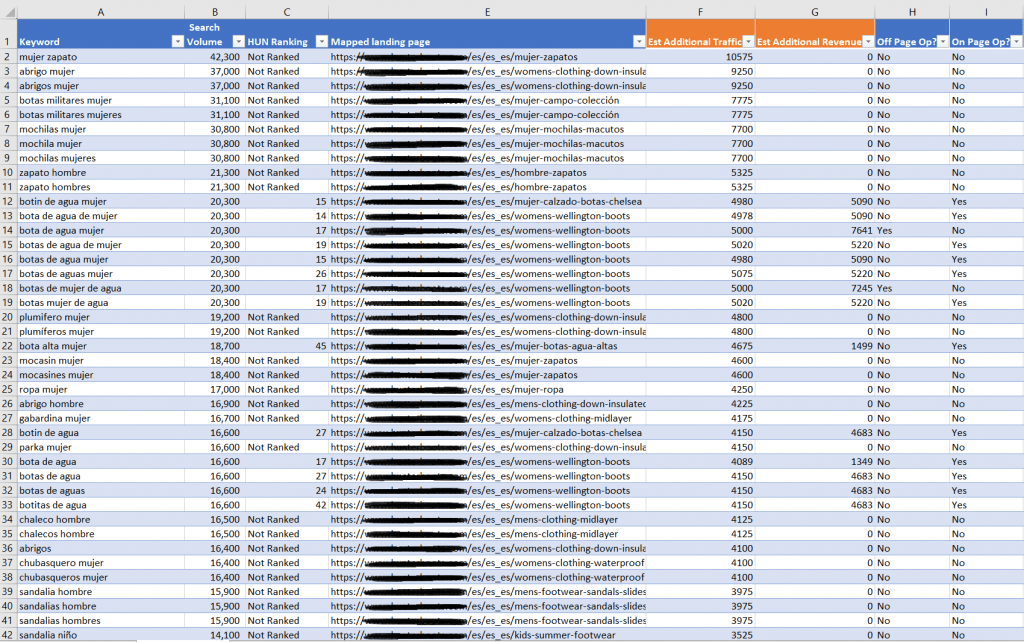
The optimisation notes column is where the map becomes operational. Rather than leaving it to the translator to figure out where keywords should go, this column spells it out. For example: “Change slug from /womens-wellington-boots/ to /botas-de-agua-mujer/. Include primary keyword in H1 and meta title. Use secondary keyword ‘botas de lluvia para mujer’ in the first H2.”
For projects covering multiple target languages, you can either use one tab per language within the same spreadsheet or one spreadsheet per language. One tab per language tends to work better for coordination, because the project manager can see all versions of a page side by side.
How to build a multilingual keyword map, step by step
Step 1: Inventory all pages in all language versions
Before assigning keywords, you need a complete list of every page on the site, in every language. Export your sitemap or crawl the site with a tool like Screaming Frog. Organise the URLs by page type (homepage, category pages, product pages, service pages, blog posts, landing pages) and by language version.
This inventory often reveals problems immediately. Pages that exist in English but not in Spanish. Blog posts that were translated but never optimised. Orphan pages with no internal links. These issues are easier to fix now, before you start mapping keywords.
Step 2: Complete keyword research for each language
Keyword mapping follows keyword research, not the other way around. If you haven’t done thorough multilingual keyword research yet, do that first. You need a researched list of target-language keywords with volume, difficulty, intent, and back translations before you can assign them to pages.
The research process should produce keyword clusters: groups of related keywords that share the same search intent. “Projektmanagement-Software,” “Projektmanagement-Tool,” and “bestes Projektmanagement-Programm” all belong to the same cluster because a user searching for any of them wants roughly the same thing. The cluster, not the individual keyword, is what gets mapped to a page.
Step 3: Group keywords into clusters by intent
Take your researched keyword list and sort it into clusters. Each cluster should contain:
- One primary keyword (the highest-volume, most relevant term in the cluster)
- Two to four secondary keywords (related terms, long-tail variations, question-format queries)
The binding principle is shared intent. All keywords in a cluster should lead users to the same type of content. If a keyword has different intent from the rest of the cluster (e.g., one is informational and the others are transactional), it belongs in a separate cluster mapped to a different page.
For multilingual sites, clustering must be done independently per language. Don’t assume that because five keywords cluster together in English, their translations will cluster together in Spanish. Run the SERP check for each target-language keyword to confirm that Google treats them as belonging to the same intent group.
Step 4: Match clusters to pages
This is the core of keyword mapping. For each cluster, find the page on the site that best matches its intent and topic. There are three possible outcomes:
- A page already exists and is a good match. Assign the cluster to that page. Note in the optimisation column what changes are needed (title tag, meta description, heading, slug, body content).
- A page exists but doesn’t match well. Decide whether to rework the page to fit the cluster or find a different cluster for it. Sometimes a page was created for one purpose but the keyword data suggests it should serve a different one.
- No matching page exists. This is a content gap. Flag it in the map as “page to create” and include a brief note on what the page should cover, what intent it should satisfy, and where it should sit in the site architecture.
For an e-commerce site, the matching logic typically follows a pattern:
| Page type | Keyword intent it should target | Example primary keyword |
|---|---|---|
| Homepage | Brand + core category (navigational) | [Brand name] + main product category |
| Category pages | Broad commercial/transactional | “zapatillas de running” (running trainers) |
| Product pages | Specific transactional | “Nike Pegasus 41 mujer” (Nike Pegasus 41 women’s) |
| Comparison/guide pages | Commercial investigation | “mejores zapatillas para correr 2026” (best running shoes 2026) |
| Blog posts | Informational | “cómo elegir zapatillas de running” (how to choose running shoes) |
| FAQ/help pages | Informational (Know Simple) | “talla zapatillas running equivalencia” (running shoe size conversion) |
Step 5: Check for cannibalisation
After mapping all clusters, scan the map for conflicts. Two things to look for:
Within-language cannibalisation: Are two pages in the same language targeting the same primary keyword or very close variants? “Zapatillas de running para mujer” and “zapatillas running mujer” are close enough that Google will treat them as competing. Consolidate them onto one page.
Cross-language cannibalisation: Is the English version of a page outranking the localised version in the target market? This usually indicates a technical issue (missing or incorrect hreflang tags, thin localised content) rather than a keyword mapping problem, but the map is where you catch it. If the English page has rich, keyword-optimised content and the Spanish page is a bare-bones translation, Google may prefer the English page even for Spanish-speaking users.
Tools that help with cannibalisation checks include Semrush’s Cannibalization Report within Position Tracking, Ahrefs’ Site Explorer (filter by keyword to see which URLs rank), and Google Search Console (filter queries by page to spot overlaps).
Step 6: Add optimisation recommendations
For each page-keyword pairing, specify where the keywords should appear:
- Title tag: Include the primary keyword. Keep under 60 characters for display. For non-English languages, character limits may differ due to word length (German compound nouns, for instance, are often longer).
- Meta description: Include primary or secondary keyword naturally. Under 155 characters. Write this from scratch in each language rather than translating the English meta description, because click-through rates depend on local phrasing.
- H1: Should contain or closely reflect the primary keyword.
- URL slug: Should contain the primary keyword or a short version of it in the target language. Don’t leave English slugs on localised pages.
- Body content: Primary keyword in the first 100 words and naturally throughout. Secondary keywords in subheadings and body paragraphs. Don’t force a keyword count. If the content reads naturally and covers the topic thoroughly, keyword density will take care of itself.
Step 7: Document and share
Save the map in a shared location (Google Sheets works well for collaboration). Set up tabs per language if working across multiple markets. Assign owners for each section. The map is a living document. It gets updated when new pages are created, when keyword performance data comes in, and when market conditions change.
Different workflows for working with SEO translators
How the keyword map gets used depends on the project setup. We see four common workflows at Crisol, and each one is valid depending on the client’s team structure and budget.
Workflow 1: Marketer sends mapped source-language keywords → translator localises them. The client provides a completed English keyword map and asks the SEO translator to find equivalent target-language keywords for each assignment. The page-to-keyword structure stays the same; only the keywords change language. This is the fastest workflow but carries risk if intent shifts between markets, because the translator is inheriting the English mapping logic without questioning it.
Workflow 2: Marketer sends source keywords → translator localises keywords → translator maps them to target pages. The translator has more control here. After researching target-language equivalents, they review the target-language site and map the keywords themselves, adjusting assignments where the intent in the target market doesn’t match the English mapping. This produces better results for markets where cultural or behavioural differences are significant.
Workflow 3: In-house team localises keywords → translator reviews and maps. A bilingual member of the marketing team does the initial keyword localisation. The SEO translator then reviews the keyword choices for accuracy and intent alignment, and maps them to pages. This works well when the in-house team has some local market knowledge but lacks SEO specialisation.
Workflow 4: Translator researches keywords from scratch → client approves → translator maps. No reference to the source-language keywords at all. The translator conducts independent keyword research in the target market, proposes keywords, gets approval, and maps them. This is the most thorough approach and the one we recommend for markets where the product category, user behaviour, or competitive environment differs substantially from the source market.
What happens after mapping: getting keywords into the content
The keyword map is a plan. The content is the execution. There are several ways to get the mapped keywords into localised pages.
Injecting keywords into already-translated content
If the pages have already been translated, the SEO translator goes through each one and inserts the target-language keywords in the title tag, meta description, headings, slug, and body copy. This is relatively quick but has a limitation: forcing keywords into existing text can disrupt the flow, especially if the translation was done without SEO in mind. The results tend to be adequate but not optimal.
Writing new localised content from the keyword map
The SEO translator uses the keyword map as a content brief and writes (or rewrites) each page from scratch in the target language, building the content around the mapped keywords. This produces the strongest SEO results because the keywords are woven in from the start rather than bolted on afterwards. It’s also the most time-consuming and expensive option. We recommend this approach for high-value pages like homepage copy, core service pages, and pillar content.
Hybrid: rewriting key sections while keeping the structure
A middle ground. The translator keeps the overall structure and some existing paragraphs but rewrites headings, introductions, meta data, and key sections to incorporate the mapped keywords naturally. This balances SEO impact with cost efficiency and is the most common approach for blog posts, support articles, and secondary pages.
Source-language keyword insertion before translation
If the client’s English copywriter inserts the English keywords into the source text before sending it for translation, the SEO translator can use the marked-up source as a guide for where keywords should appear in the target text. The translator replaces each English keyword with its mapped target-language equivalent during the translation process. This workflow is efficient when the keyword map has been agreed on beforehand and the translator understands that keyword placement matters as much as linguistic accuracy.
Maintaining the keyword map over time
A keyword map isn’t a one-off deliverable. Search behaviour shifts, competitors publish new content, and Google changes how it ranks pages. For multilingual sites, there’s an additional reason to maintain the map: new markets get added, existing markets get more competitive, and language-specific trends emerge that weren’t relevant when the map was first created.
Review the map quarterly at minimum. During each review:
- Check rankings for each primary keyword using Google Search Console or your SEO tool, filtered by country.
- Identify pages where rankings have dropped and investigate whether the keyword assignment is still correct or whether intent has shifted.
- Look for new keyword opportunities that have emerged since the last review, especially in markets where search behaviour is evolving quickly.
- Update the status column to reflect which pages have been optimised, which need refreshing, and which are still pending.
- Add new pages as they are created and assign keyword clusters before the content is written, not after.
For larger sites, a quarterly review per language is a substantial time investment. Prioritise the pages and keywords that drive the most traffic and revenue, and work outward from there.
Keyword mapping and AI-powered search in 2026
AI Overviews, ChatGPT search, Perplexity, and other AI-driven search tools are changing how content gets surfaced. For keyword mapping, the main implication is that topic coverage matters as much as keyword targeting. AI systems synthesise information from multiple sources, and they tend to cite pages that cover a topic comprehensively and are well-connected to related pages through internal links.
A strong keyword map supports this by design. When every page has a clear keyword cluster and links to related pages through a deliberate internal linking strategy, AI systems can crawl the site’s topical structure and identify it as a coherent source on the subject. Scattered, unmapped content is harder for AI to synthesise and less likely to be cited.
For multilingual sites specifically, ensure that each language version builds its own topical authority independently. A comprehensive English-language hub page doesn’t transfer its authority to a thin Spanish translation. The Spanish version needs its own keyword map, its own internal links, and its own depth of content to be cited by AI systems serving Spanish-speaking users.
How Crisol handles keyword mapping for international brands
At Crisol Translation Services, keyword mapping is part of every SEO translation and website localisation project we deliver. Our SEO translators build keyword maps that cover the full spreadsheet structure described above, with primary and secondary keywords researched independently in each target market, intent classifications validated against the local SERP, and optimisation notes that tell the translator or copywriter exactly where and how to use each keyword.
We work in English, Spanish (with separate research for each Latin American market and Spain), and German. Whether you need a keyword map for a new market entry, a remapping of an existing multilingual site, or keyword mapping as part of a larger SEO localisation project, our team handles the research, the mapping, and the content implementation.
Get in touch to talk about your project.
Frequently asked questions about keyword mapping in multilingual SEO
What is keyword mapping? Keyword mapping is the process of assigning researched keywords to specific pages on a website based on the intent behind those keywords. It answers the question: which page on this website is the right one to target this keyword? In multilingual SEO, it adds the step of aligning foreign-language content with the corresponding target-language keywords across each market’s language version of the site.
Why is keyword mapping necessary? Without mapping, the same keyword may end up targeted by multiple pages (keyword cannibalisation), or important keywords may have no page optimised for them at all. Mapping gives you visibility into where optimisation effort is most needed, prevents pages from competing against each other, and creates a plan that connects content decisions to specific ranking targets. It is also how you identify existing pages that could be updated to target a keyword rather than creating new content from scratch.
What does a keyword mapping document look like? Typically a spreadsheet with columns for page ID, URL, primary target keyword (with search volume), a back-translation of the keyword if the client doesn’t read the target language, and optimisation recommendations for page elements (title, meta description, URL slug, headings). For multilingual sites, the document covers each language version with the market-specific keywords assigned to the equivalent page in each language.
What is keyword cannibalisation and how does mapping prevent it? Keyword cannibalisation happens when multiple pages on the same site target the same keyword, causing them to compete against each other and dilute the ranking signal for all of them. Mapping prevents this by assigning each keyword to exactly one page across the site. If two pages would otherwise target the same term, mapping forces a decision about which page is the better fit and what alternative keyword the other page should target instead.
What is the role of search intent in keyword mapping? Keywords should be mapped based on the intent they reflect, not just topical relevance. A user searching “how to install a door frame” has informational intent and should land on a how-to guide. A user searching “joinery services Surrey” has commercial investigation intent and should land on a service page. Mapping keywords that share the same intent to the same page, even if they look like different queries, produces better results than treating each keyword variation as a separate page.
How does keyword mapping work with SEO translators? The typical workflow involves completing keyword research in the target language first, then mapping the foreign-language keywords to the equivalent pages on the localised site before any translation begins. This ensures translators know which primary and secondary keywords to integrate into each page. Some SEO translators conduct the keyword research and mapping themselves as part of the service; others receive a keyword mapping document from the client’s SEO team and work to it.

Author: Maria Scheibengraf
Maria Scheibengraf is an English-to-Spanish marketing and SEO translator specialised in software (SaaS, martech, fintech), and Operations Manager at Crisol Translation Services, which she co-founded in 2016. With a solid background in programming and marketing, Maria has an in-depth understanding of the technical intricacies involved in software programs, websites, and digital platforms. Maria is also the author of The SEO Translation Bible.


