
Transadaptation is the process of adapting content within the same language to suit a different regional variety or market. If your company sells in both Spain and Mexico, for example, you wouldn’t commission two separate translations from English. You’d translate once into one Spanish variety and then transadapt into the other. It saves money and preserves consistency across markets, while making sure each audience reads content that feels locally written.
The term was first popularised by translation scholar Yves Gambier, who described it as a concept that moves beyond the usual dichotomy of literal versus free translation, placing the target audience front and centre.
This guide covers everything you need to know about transadaptation: how it differs from translation, localisation, transcreation, and blind transcreation, when to use it, what it costs, how the process works in practice, and which language pairs benefit from it most.
In this post:
- Where transadaptation sits in the language services spectrum
- Why transadaptation matters for global businesses
- How transadaptation works in practice
- Transadaptation is usually charged by the hour
- Transadaptation across English varieties
- Transadaptation across Spanish varieties
- Transadaptation for other languages
- When transadaptation is the right choice (and when it's not)
- The role of transadaptation in SEO and content strategy
- Transadaptation and AI: can machines do it?
- A real-world transadaptation workflow
- F
- Get your content transadapted by people who understand regional variation
- Frequently asked questions about transadaptation
Where transadaptation sits in the language services spectrum
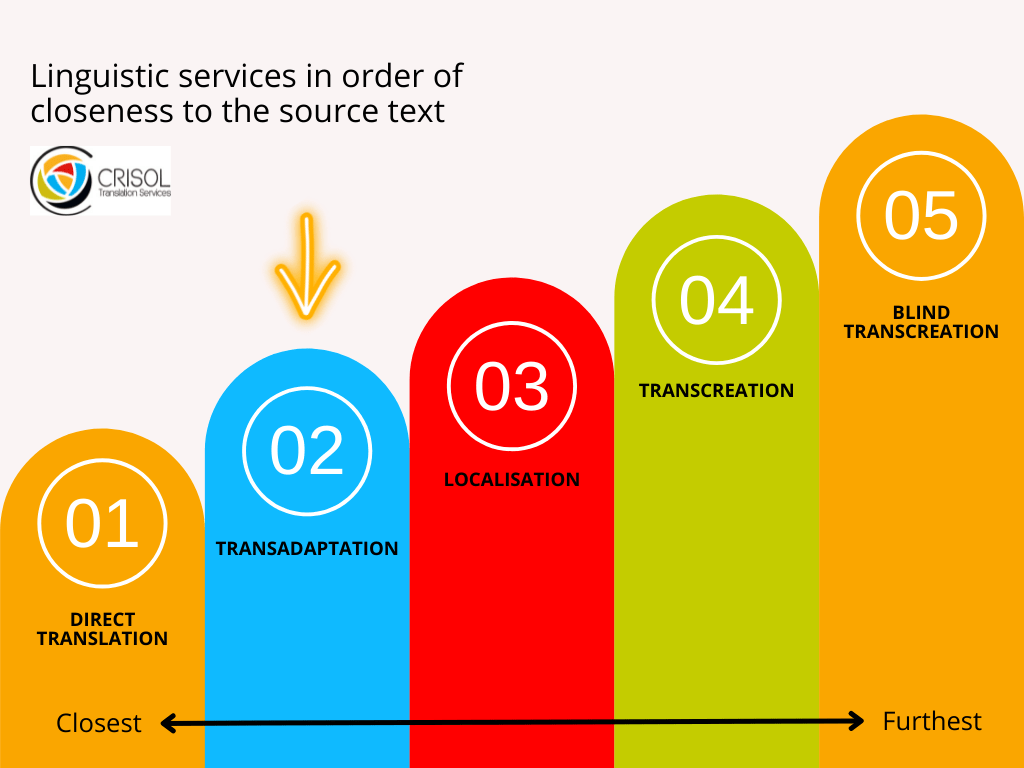
To understand transadaptation, it helps to see where it falls among the other services available when you need content in another language or variety.
| Service | What changes | Stays close to the source? | Typical use case |
|---|---|---|---|
| Translation | Language (word-for-word transfer of meaning) | Yes | Technical manuals, legal documents, factual content |
| Transadaptation | Regional vocabulary, spelling, idioms, register, cultural references within the same language | Mostly yes | Expanding from one regional variety to another (e.g. US English to UK English, or European Spanish to Mexican Spanish) |
| Localisation | Language plus non-textual elements (currencies, date formats, images, UX, legal requirements) | Partially | Software, ecommerce sites, mobile apps |
| Transcreation | Message, tone, emotional triggers (may rewrite entirely) | Often no | Taglines, advertising campaigns, brand slogans |
| Blind transcreation | Everything (source text is not provided to the writer) | No | Emotionally charged marketing where the source would constrain creativity |
What sets transadaptation apart from all of the above is that it works within a single language. You’re adapting British English to American English, or Castilian Spanish to Mexican Spanish. The language itself stays the same; what changes is the way it sounds and feels to a different group of native speakers.
Why transadaptation matters for global businesses
Research consistently shows that consumers prefer engaging with brands in their own language variety, and the numbers behind this are hard to ignore.
CSA Research’s “Can’t Read, Won’t Buy” study surveyed 8,709 consumers in 29 countries and found that 76% of online shoppers prefer to buy products with information in their own language. 40% will outright refuse to buy from a website in another language.
But language preference goes deeper than simply “Spanish or not Spanish.” A Mexican reader encountering Castilian Spanish phrasing on a product page will notice. They might not leave immediately, but trust erodes because the content feels slightly foreign. In competitive markets, that faint sense of distance is enough to push a potential customer towards a competitor whose content reads like it was written down the road.
The global language services market was valued at USD 75.16 billion in 2024 and is projected to reach USD 137.2 billion by 2034. Much of that growth is driven by businesses realising that one-size-fits-all translations aren’t enough. Transadaptation is one of the most cost-effective ways to close the gap between technically correct and locally persuasive.
How transadaptation works in practice
The process typically follows one of two routes, depending on whether there’s already a translation involved.
Route 1: translate, then transadapt
This is the most common workflow. Imagine a US-based SaaS company that needs its marketing content in Mexican Spanish, Argentine Spanish, European Spanish, and Colombian Spanish.
Instead of hiring separate translators for each variety (and paying full translation rates for each), the company commissions one translation into, say, Mexican Spanish. A transadaptor then adjusts that translated text for the Argentine and European Spanish markets.
The transadaptor modifies vocabulary (e.g. “computadora” in Mexico becomes “ordenador” in Spain), adjusts register and formality (the use of “tú” versus “vos” versus “usted” varies significantly across regions, something we’ve covered in detail in our guide to voseo), tweaks idiomatic expressions so they land naturally, and recalibrates cultural references that might not resonate in the target market.
Route 2: transadapt without translating
Sometimes there’s no translation step at all. A company based in the UK might want to expand to the US market. The content is already in English. It needs to be in American English.
This involves changing spelling (“colour” to “color,” “organisation” to “organization”), swapping vocabulary (“boot” to “trunk,” “flat” to “apartment”), adjusting cultural references and measurement systems (metric to imperial), and sometimes reworking entire passages where the tone or humour doesn’t cross the Atlantic well.
Transadaptation is usually charged by the hour
Unlike translation, which is typically priced per word, transadaptation is most often charged by the hour. The amount of work varies enormously depending on how different the two varieties are and how creative the content is.
A technical manual moving from US English to UK English? Mostly spelling changes and a handful of vocabulary swaps. A few hours of work, even for a lengthy document.
A brand campaign moving from European Spanish to Rioplatense Spanish? That could involve rethinking idioms, adjusting verb conjugations (voseo patterns change the entire verb morphology), replacing cultural references, and reconsidering the overall tone. More time, more cost, but still significantly cheaper than commissioning a full translation from scratch.
| Content type | Approximate transadaptation effort (relative to full translation) |
|---|---|
| Technical documentation | 15–25% |
| Product descriptions | 20–35% |
| Blog posts and articles | 25–40% |
| Marketing copy and ads | 35–60% |
| Creative/brand campaigns | 50–70% |
These figures are rough estimates based on industry experience. The actual effort depends on the specific variety pair and the text itself. A product description loaded with colloquialisms will need more work than one that sticks to straightforward feature descriptions.
Transadaptation across English varieties
English has dozens of regional varieties. The differences between them are mostly lexical and orthographic, which means transadaptation between English varieties tends to be relatively light.
Spelling differences
American English and British English diverge on hundreds of words. Some of the most common patterns:
| Pattern | American English | British English |
|---|---|---|
| -ize / -ise | organize, realize | organise, realise |
| -or / -our | color, favor | colour, favour |
| -er / -re | center, theater | centre, theatre |
| -og / -ogue | catalog, dialog | catalogue, dialogue |
| -ense / -ence | defense, license (noun) | defence, licence (noun) |
Other varieties like Australian English, Canadian English, New Zealand English, and South African English each have their own preferences, sometimes aligning with British conventions and sometimes with American ones. Canadian English, for instance, uses British “-our” spellings but American “-ize” endings. Australian English largely follows British conventions but has its own vocabulary (think “ute” for pickup truck, or “arvo” for afternoon).
Vocabulary differences
Beyond spelling, certain words mean completely different things depending on the region. “Pants” in American English means trousers; in British English it means underwear. “Biscuit” in the UK is a cookie in the US. “Thong” in Australia is a flip-flop elsewhere. And “chips” refers to crisps in the US but to thick-cut fried potatoes in the UK.
For ecommerce businesses, these differences directly affect whether a customer finds your product. If your UK ecommerce site sells “trainers” but your American customers are searching for “sneakers,” transadaptation is what bridges that gap. And it matters for SEO too: your multilingual keyword research needs to reflect the vocabulary each audience actually uses in search.
Transadaptation across Spanish varieties
Spanish is where transadaptation gets genuinely complex. With over 500 million native speakers spread across more than 20 countries, the variation within Spanish far exceeds what you find among English varieties.
The broad groupings are:
- European Spanish (Castilian, Andalusian, Canarian, and other peninsular varieties)
- Mexican and Central American Spanish (by far the largest speaker population in Latin America)
- South American Spanish (Rioplatense, Colombian, Andean, Chilean, and others, each with distinct characteristics)
- US Spanish (a diverse mix influenced by Mexican, Caribbean, Central American, and South American communities)
Vocabulary can be wildly different
The same object can have completely different names depending on the country. This table gives a flavour of how varied it gets:
| English | Spain | Mexico | Argentina | Colombia |
|---|---|---|---|---|
| Computer | Ordenador | Computadora | Computadora | Computador |
| Car | Coche | Carro / Coche | Auto | Carro |
| Bus | Autobús | Camión | Colectivo | Bus |
| Apartment | Piso | Departamento | Departamento | Apartamento |
| Mobile phone | Móvil | Celular | Celular | Celular |
| Jacket | Chaqueta | Chamarra | Campera | Chaqueta |
For a company selling, say, jackets online, using “chaqueta” in an ad targeting Argentine consumers would feel off. It’s the kind of subtle misfit that erodes trust.
Grammar changes too
The most significant grammatical difference across Spanish varieties is pronoun usage. Spain uses “vosotros” as the informal second-person plural, while virtually all of Latin America uses “ustedes.” Several Latin American countries, including Argentina, Uruguay, and parts of Central America, use “vos” instead of “tú” for the informal second-person singular, a phenomenon known as voseo.
Voseo doesn’t only change the pronoun. It changes the verb conjugation entirely. “Tú tienes” (you have) becomes “vos tenés.” “Tú puedes” (you can) becomes “vos podés.” For software interfaces and app localisation, this affects button labels, instructional prompts, error messages, tooltips, and essentially any text the user sees on screen.
Register and formality differ across regions
Some Spanish-speaking countries lean towards more formal address in professional contexts, while others are considerably more relaxed. Colombian Spanish, for instance, tends towards greater formality and politeness in business communication compared to Argentine Spanish, where informality is more readily accepted.
These differences in register directly affect how marketing copy should be written. A casual, direct tone that works well for a Mexican audience might feel abrupt to a Colombian reader. This is the kind of nuance that a transadaptor catches and a machine translation engine doesn’t.
Transadaptation for other languages
Spanish and English aren’t the only languages where regional variation demands transadaptation. Here are a few other common cases:
| Language | Key regional varieties | Typical differences |
|---|---|---|
| Portuguese | Brazilian vs. European | Spelling (post-2009 orthographic agreement narrowed but didn’t eliminate differences), vocabulary, grammar (Brazilian Portuguese places pronouns differently and has distinct verb constructions), register |
| French | Metropolitan French vs. Canadian (Québécois) vs. Belgian vs. Swiss | Vocabulary, anglicisms (Québécois resists them far more than Metropolitan French), numerical conventions, formality levels |
| German | German (Germany) vs. Austrian vs. Swiss German | Vocabulary (German “Tomate” vs. Austrian “Paradeiser”), spelling conventions, food terminology, legal/administrative terminology |
| Chinese | Simplified (mainland China) vs. Traditional (Taiwan, Hong Kong) | Character sets, vocabulary, cultural references, political sensitivities |
| Arabic | Modern Standard Arabic vs. regional dialects (Egyptian, Gulf, Levantine, Maghrebi) | Written MSA is largely shared, but marketing and conversational content needs dialectal adaptation |
For any language with significant regional variation, transadaptation is the bridge between grammatically correct and locally natural.
When transadaptation is the right choice (and when it’s not)
Transadaptation makes sense when your content is already translated into one variety and you need to expand to other markets that speak the same language. It’s particularly effective for:
- Ecommerce product catalogues expanding from one Spanish-speaking market to several others
- SaaS companies adapting their interface and help documentation across English or Spanish varieties
- Content marketing that needs to feel locally relevant without rewriting from scratch
- SEO-translated content targeting keywords in different regional varieties
Transadaptation reaches its limits when the differences between markets go beyond language. Changing imagery, reworking pricing structures, adapting to different legal frameworks, or redesigning the user experience all fall under full localisation. And when the marketing message itself needs to change to resonate emotionally with a new audience, you’re in transcreation territory.
The decision often comes down to how much of the content is culturally neutral versus culturally loaded. A SaaS knowledge base article with straightforward product explanations is a strong candidate for transadaptation. A Christmas campaign built around deeply local humour probably needs transcreation, because the emotional payload of the message is the whole point.
The role of transadaptation in SEO and content strategy
Search engines don’t treat all Spanish (or all English, or all Portuguese) as one monolithic language. Google distinguishes between es-ES, es-MX, es-AR, and other locale-specific versions. If your content only targets one variety, you may be leaving significant organic traffic on the table in other markets.
Transadaptation plays a direct role in SEO translation and international content strategy in several concrete ways:
Keyword variance across regions. The same product gets searched with different terms in different countries. “Zapatillas” in Argentina, “tenis” in Mexico, “deportivas” in Spain. If your Spanish content only uses one of these terms, you’re invisible in the other markets. Multilingual keyword research identifies these differences; transadaptation implements them.
Hreflang implementation. When you transadapt content for multiple varieties of the same language, you’ll need proper hreflang tags to tell search engines which version to serve to which audience. Without hreflang, Google may treat your Argentine Spanish and Mexican Spanish pages as duplicates and only index one.
User engagement signals. Content that feels locally written keeps readers on the page longer. Bounce rates drop, time-on-page rises, and these engagement signals feed back into rankings. A Mexican reader who lands on a page written in Castilian Spanish is more likely to bounce than one who reads content in their own variety.
Backlink relevance. Search engines also consider the geographic origin of your backlinks. A link from a Mexican news site carries more weight for Mexican rankings than one from a Spanish blog. Transadapted content opens the door to earning backlinks from publishers in each specific market.
Transadaptation and AI: can machines do it?
Machine translation engines have improved dramatically, and some now offer regional variant options. Google Translate, for instance, began offering country-specific Spanish outputs in recent years. But for professional transadaptation, machine tools still fall short in critical areas.
Machines handle spelling differences and common vocabulary swaps reasonably well. Where they struggle is with register, idiomatic expressions, humour, cultural references, and the kind of tonal calibration that makes copy feel local rather than merely correct.
For high-volume, low-stakes content (think internal documentation or knowledge base articles), a machine-assisted workflow with human review can work. For anything customer-facing or emotionally charged, human transadaptors remain essential. The role of AI in multilingual content is growing, but it works best when paired with human expertise.
A real-world transadaptation workflow
A typical transadaptation project looks like this from start to finish:
- Source audit. The transadaptor reviews the source content to assess volume, content type, and the level of regional specificity in the existing text.
- Variety mapping. The client and transadaptor agree on which target varieties are needed and flag any particularly sensitive terms, brand-specific vocabulary, or style requirements.
- Keyword research (for web content). If the content will be published online, the transadaptor or an SEO specialist identifies the target keywords in each regional variety.
- Transadaptation. The transadaptor works through the text, modifying vocabulary, spelling, grammar, idioms, cultural references, and register as needed for each target variety.
- Quality assurance. A native speaker of each target variety reviews the transadapted text. This is analogous to the editing step in a standard TEP (Translation, Editing, Proofreading) process.
- Delivery and implementation. The transadapted content is delivered and published, with appropriate hreflang tags or other locale-targeting mechanisms in place.
The whole process is faster and cheaper than commissioning separate translations for each variety. For a 10,000-word marketing website being transadapted from Mexican Spanish to two additional Spanish varieties, you might save 40–60% compared to translating the full content twice from scratch.
Get your content transadapted by people who understand regional variation
At Crisol Translation Services, we specialise in marketing translation, SEO translation, website localisation, and transcreation for businesses expanding into English, Spanish, and German-speaking markets. Transadaptation is a core part of what we do, and our translators are native speakers of specific regional varieties, not generic Spanish or English speakers.
We help companies take European Spanish content into Latin American markets, adapt US English websites for UK audiences, fine-tune German copy for Austrian readers, and handle everything in between. We combine linguistic precision with multilingual keyword research to make sure your transadapted content performs in search as well as it reads on the page.
Get in touch to discuss your transadaptation project.
Frequently asked questions about transadaptation
What is transadaptation? Transadaptation is the adaptation of content within the same language to make it fit for a target audience in a different region or market. If the full range of translation services exists on a continuum from direct translation at one end to transcreation at the other, transadaptation sits between direct translation and full localisation: it only involves textual changes, without the broader redesign or cultural overhaul that complete localisation can require.
How is transadaptation different from localisation? Localisation typically encompasses everything that might need to change for a new market: images, colours, design, formats, and cultural references alongside the text. Transadaptation focuses specifically on adapting the text itself to suit a different variety of the same language, for example adapting content written in European Spanish for Mexican or Argentine audiences, or adapting American English content for British or Australian markets.
When is transadaptation the right choice? When a client needs content adapted for multiple varieties of the same language and hiring a separate native translator for each variety would be prohibitively expensive. The more efficient approach is to complete the translation from the source language into one target variety first, and then transadapt that output into the additional varieties needed. This works particularly well when the differences between varieties are primarily lexical and register-based rather than conceptual or structural.
What kinds of differences does transadaptation address? Vocabulary differences (courgette in British English versus zucchini in American English; ordenador in Spain versus computadora in Mexico). Register and formality (different address forms, different degrees of directness in commercial copy). Spelling and punctuation conventions that differ between English varieties. Cultural references that need updating for the new audience. And idioms that do not transfer between varieties even within the same language.
How is transadaptation priced? It is usually charged by the hour rather than per word, because the amount of work varies significantly depending on how closely related the source and target varieties are and how creative the text is. A technical manual with mostly neutral vocabulary may require very few changes between European and Latin American Spanish. A lifestyle marketing text may need much more substantial reworking. The hourly model reflects this variability better than a per-word rate.

Author: Maria Scheibengraf
Maria Scheibengraf is an English-to-Spanish marketing and SEO translator specialised in software (SaaS, martech, fintech), and Operations Manager at Crisol Translation Services, which she co-founded in 2016. With a solid background in programming and marketing, Maria has an in-depth understanding of the technical intricacies involved in software programs, websites, and digital platforms. Maria is also the author of The SEO Translation Bible.


