
Localisation is the process of adapting a product, service, or piece of content to meet the linguistic, cultural, and functional expectations of a specific market. It goes well beyond swapping words from one language to another. Where translation transfers meaning between languages, localisation reshapes the entire experience so it feels native to the person using it – from the text on a button to the colour of an icon to the way a date is displayed.
The term is sometimes spelled “localization” (American English) or abbreviated to l10n, a numeronym where the 10 represents the ten letters between the “l” and the “n”. Both spellings refer to the same process.
If you’ve ever opened an app and immediately known it was built for someone in a different country – the currency was wrong, the date format looked odd, or the tone felt off – you’ve experienced what happens when localisation is missing. When it’s done well, you don’t notice it at all.
In this post:
- How localisation differs from translation
- Where localisation sits: the GILT framework
- What actually gets localised
- The adaptation spectrum
- Locales: why language alone isn't enough
- Culture and localisation: beyond language
- Why localisation matters: what the research says
- What happens when localisation goes wrong
- How localisation intersects with SEO
- Localisation by sector
- Localisation and AI: where things stand
- What happens when localisation goes right
- Key terminology at a glance
- How to get started with localisation
- Need help localising your content?
- Frequently asked questions about localisation
How localisation differs from translation
Translation converts written content from one language to another. Localisation includes translation but extends to everything else that shapes how a user perceives and interacts with a product.
Here’s a practical breakdown:
| Element | Translation | Localisation |
|---|---|---|
| Written text | ✅ Converted to target language | ✅ Converted and culturally adapted |
| Date and time formats | ❌ Left as source | ✅ Adjusted (e.g. MM/DD/YYYY → DD/MM/YYYY) |
| Currency and units | ❌ Left as source | ✅ Converted to local standards |
| Images and graphics | ❌ Unchanged | ✅ Replaced or modified for cultural fit |
| Colours and symbols | ❌ Unchanged | ✅ Checked for cultural meaning |
| Text direction | ❌ Not addressed | ✅ Adapted (e.g. LTR → RTL for Arabic) |
| Legal and regulatory content | ❌ Translated literally | ✅ Adapted to local laws and norms |
| UX layout and design | ❌ Unchanged | ✅ Adjusted for text expansion and reading patterns |
| Tone and register | ⚠️ May preserve source tone | ✅ Matched to local communication style |
| SEO and discoverability | ❌ Not addressed | ✅ Keywords researched for local search behaviour |
The distinction matters because a translated product can still feel foreign. A localised product shouldn’t.
That said, the line between translation and localisation is blurrier than most industry definitions suggest. A good translator already adapts idioms and adjusts register based on context – all of which overlaps with what localisation aims to achieve. The difference is really one of scope: translation focuses on the text, while localisation considers the full experience surrounding it.
For a deeper look at the various ways translation adapts to different contexts, see our guide to types of translation.
Where localisation sits: the GILT framework
Localisation doesn’t happen in isolation. It’s one stage in a broader process that the language industry refers to as GILT: Globalisation, Internationalisation, Localisation, and Translation.
| Stage | Abbreviation | What it covers | Who’s typically involved |
|---|---|---|---|
| Globalisation | g11n | The overarching business strategy to enter international markets – market selection, regulatory planning, supply chain, pricing | C-suite, strategy teams |
| Internationalisation | i18n | Designing products so they can be adapted for any market without re-engineering – Unicode support, flexible layouts, externalised strings | Developers, product teams |
| Localisation | l10n | Adapting a product for a specific market’s language, culture, and expectations | Translators, localisation specialists, marketers |
| Translation | t9n | Converting text from one language to another | Translators, MT engines |
Each stage feeds the next. Globalisation sets the direction. Internationalisation prepares the infrastructure. Localisation adapts for specific markets. Translation handles the linguistic conversion within that adaptation.
Why the sequence matters
A common mistake is skipping straight from globalisation to translation – deciding to enter a market, then translating the website. Without internationalisation (the technical groundwork) and localisation (the cultural adaptation), the result tends to be a product that technically speaks the language but misses everything else.
Consider a SaaS company that decides to launch in Japan. If the product was never internationalised – if the UI can’t handle double-byte characters, if date fields are hard-coded to Western formats, if text boxes can’t accommodate the vertical writing some Japanese contexts use – then no amount of translation will produce a usable product. The internationalisation step needed to happen during development, long before the translators were brought in.
The W3C’s Internationalization Activity provides detailed guidance on how internationalisation and localisation relate, particularly for web and software contexts. We cover the technical side in more depth in our internationalisation guide.
What actually gets localised
The word “localisation” gets thrown around loosely, but what does the process involve in practical terms? It spans four main categories.
Linguistic elements
- Body text, UI copy, and microcopy: Every user-facing string, from onboarding screens and push notifications to error messages and tooltip text
- Idioms and cultural references: Expressions that don’t transfer across cultures get rewritten, not translated literally. “It’s raining cats and dogs” would be baffling in most languages – in Spanish, the equivalent is “llueve a cántaros” (it’s raining pitchers), while in German it’s “Es regnet in Strömen” (it’s raining in streams)
- Tone and register: Formal vs. informal address varies by market. German software interfaces commonly use “Sie” (formal you), while many Spanish-speaking markets default to informal “tú” – though this varies by country. In Japanese, keigo (honorific language) adds multiple levels of politeness that don’t exist in English at all
- Humour: What’s funny in the UK often falls flat in Japan. Sarcasm, wordplay, and cultural in-jokes rarely survive translation intact. Humour is one of the most difficult elements to localise because it depends on shared cultural reference points that differ from market to market – a pun that works in English might need to be completely reimagined in the target language to land with the same effect
- SEO elements: Title tags, meta descriptions, URLs, and keywords all need to be researched and adapted for local search behaviour, not translated from the source language
Visual and design elements
- Images and photography: People, settings, gestures, and body language that resonate in one culture may confuse or offend in another. Stock photography featuring white American families won’t feel relatable to audiences in Southeast Asia
- Colour palette: White signifies purity in many Western cultures but is associated with mourning across parts of East Asia. Red means luck and prosperity in China but signals danger or warning in parts of Europe. Green carries religious connotations in Islamic cultures that it doesn’t carry elsewhere
- Icons and symbols: A postbox icon looks different in the UK, the US, and Japan. A thumbs-up gesture is offensive in parts of the Middle East. The “checkmark” symbol means correct in some cultures but can indicate an error in Japan, where a circle (◯) is used instead
- Layout and text expansion: German text runs roughly 30% longer than English. Arabic and Hebrew read right-to-left. Chinese and Japanese can be written vertically. All of these require UI adjustments – buttons that fit “Submit” might not fit “Absenden” without resizing
Functional and technical elements
These are the details that users notice immediately when they’re wrong:
| Element | UK format | US format | German format | Japanese format |
|---|---|---|---|---|
| Date | 11/02/2026 | 02/11/2026 | 11.02.2026 | 2026年2月11日 |
| Number (thousand) | 1,000 | 1,000 | 1.000 | 1,000 |
| Decimal | 1.50 | 1.50 | 1,50 | 1.50 |
| Currency placement | £15.00 | $15.00 | 15,00 € | ¥1,500 |
| Address format | Street, City, Postcode | Street, City, State ZIP | Street, PLZ City | 〒Postcode Prefecture City Street |
| Paper size | A4 | Letter | A4 | A4/B5 |
| First day of week | Monday | Sunday | Monday | Sunday |
Beyond formatting, functional localisation also covers:
- Payment methods: Dutch users expect iDEAL, Brazilian users want Boleto or Pix, Japanese users use convenience store payments (konbini). A checkout page that only shows Visa and Mastercard will lose conversions in markets where alternative payment methods dominate
- Legal compliance: Privacy policies must reflect local data protection laws (GDPR in Europe, LGPD in Brazil, PIPA in South Korea). Cookie consent mechanisms, terms of service, refund policies, and age verification requirements vary by jurisdiction
- Phone number validation: International dialling codes, number length, and formatting conventions differ. A form that expects a 10-digit US phone number will reject valid numbers from most other countries
Content and marketing elements
- Brand slogans and taglines: These almost always need transcreation rather than translation, because they rely on wordplay, rhythm, or cultural resonance that won’t survive literal conversion
- Product names: Sometimes a product name works globally. Sometimes it doesn’t. When Mercedes-Benz first entered China, they marketed the brand as “Bēnsǐ” – which translates roughly as “rush to die”. They quickly rebranded to “Bēnchí” (dashing speed). Coca-Cola initially translated their name phonetically in China and got something close to “bite the wax tadpole” before settling on “可口可乐” (Kěkǒu Kělè), meaning “tasty happiness”
- Social proof and testimonials: Reviews and case studies from customers in the target market carry more weight than translated ones from a foreign market. A German buyer reading a testimonial from someone in Munich will trust it more than a translated review from someone in Texas
- Seasonal and holiday references: Black Friday means nothing in most of Asia. Singles’ Day (11 November) is the world’s biggest shopping event but is barely known outside China. Ramadan, Diwali, Golden Week, Día de los Muertos – campaigns that reference the wrong holidays (or ignore the right ones) signal that a brand hasn’t bothered to understand its audience
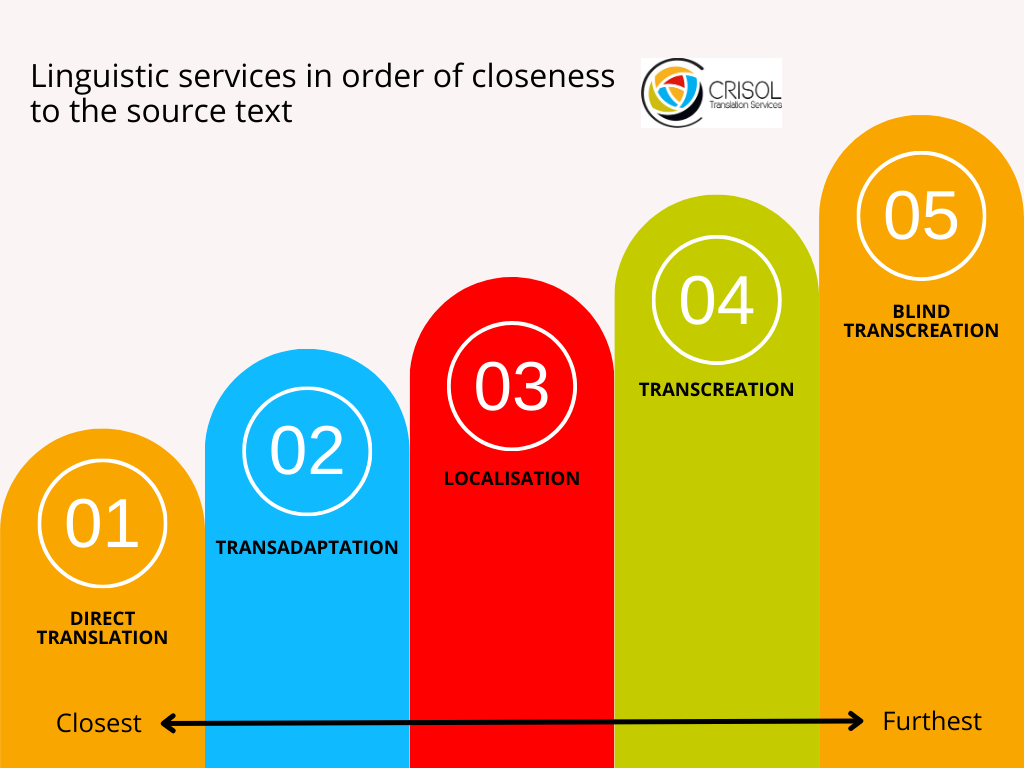
The adaptation spectrum
Localisation sits on a spectrum between literal translation and full creative reimagining. Where a project lands depends on the content type, the emotional weight of the message, and how much cultural adaptation it requires.
| Approach | What it involves | Best suited for | Level of creative freedom |
|---|---|---|---|
| Translation | Accurate linguistic transfer | Legal documents, technical manuals, patents, compliance content | Low – fidelity to source is paramount |
| Transadaptation | Same-language adaptation across regional variants | Adapting European Spanish to Latin American markets, or British English to US English | Low to medium – vocabulary and cultural references shift, structure stays |
| Localisation | Linguistic + cultural + functional adaptation | Software UI, websites, product content, ecommerce, knowledge bases | Medium – adapts experience while preserving meaning |
| Creative translation | Translation with creative licence to adapt tone, metaphor, and cultural references | Marketing website copy, brand storytelling, blog content, email campaigns | Medium to high – deviates from exact wording when it serves the content |
| Transcreation | Creative reimagining for emotional impact | Slogans, taglines, ad campaigns, brand messaging, video scripts | High – the message is recreated for emotional equivalence, not linguistic fidelity |
These aren’t rigid categories – they’re points on a continuum. A single project might need standard translation for its terms of service, localisation for its product pages, and transcreation for its advertising copy. The skill lies in knowing which approach to apply where.
If you’re working across variants of the same language – say, adapting European Spanish content for the Mexican market – transadaptation may be a more cost-effective approach than starting from scratch.
Locales: why language alone isn’t enough
One of the most misunderstood aspects of localisation is the concept of a locale. A locale is a specific combination of language and region, and it determines far more than vocabulary.
Spanish, for example, is spoken in over 20 countries. But the Spanish used in Argentina differs from the Spanish used in Mexico, which differs again from European Spanish. These differences go well beyond slang:
| Element | Spain (es-ES) | Mexico (es-MX) | Argentina (es-AR) |
|---|---|---|---|
| “You” (informal) | tú | tú | vos |
| “Computer” | ordenador | computadora | computadora |
| “Car” | coche | carro/coche | auto |
| “Cool” (slang) | mola/guay | chido/padre | copado/piola |
| Decimal separator | comma (1,50 €) | period ($1.50) | comma ($1,50) |
| Currency | EUR (€) | MXN ($) | ARS ($) |
| Formality default | Often formal (usted) in business | Mixed | Informal (vos) is standard |
Choosing “vos” vs. “tú” in a mobile app’s onboarding flow might seem like a small detail, but to an Argentine user, seeing “tú” immediately signals that the product wasn’t made with them in mind. It’s like reading a British banking app that talks about “checking accounts” instead of “current accounts” – technically comprehensible, functionally wrong.
The same applies to English. British English and American English differ in spelling (colour/color), vocabulary (boot/trunk), date formats (DD/MM vs. MM/DD), and measurement systems. Portuguese splits between pt-BR (Brazil) and pt-PT (Portugal) with significant differences in grammar, vocabulary, and register. Even Chinese has major locale splits between zh-CN (simplified, mainland China), zh-TW (traditional, Taiwan), and zh-HK (traditional, Hong Kong) – and as Nintendo learned with the Pokémon Sun and Moon launch, treating these as interchangeable can backfire.
Locale codes follow the Unicode CLDR standard and typically combine a language code with a region code: en-GB (English, United Kingdom), pt-BR (Portuguese, Brazil), zh-CN (Chinese, China). These codes determine how software handles everything from sorting order to calendar systems to pluralisation rules.
For a deeper look at how language variants affect localisation workflow, including when transadaptation can save time and budget, see our guide to adapting content across regional language variants.
Culture and localisation: beyond language
Language is only one layer of culture. Localisation that stops at linguistic accuracy misses the deeper patterns that shape how people perceive messages, make decisions, and interact with products.
High-context vs. low-context communication
Anthropologist Edward T. Hall’s distinction between high-context and low-context cultures is one of the most useful frameworks for understanding why the same message lands differently across markets.
| Characteristic | Low-context cultures | High-context cultures |
|---|---|---|
| Communication style | Direct, explicit, literal | Indirect, implicit, relies on shared understanding |
| What’s said vs. what’s meant | They’re usually the same | Often different – meaning lives between the lines |
| Typical markets | US, UK, Germany, Scandinavia, Netherlands, Australia | Japan, China, Korea, Arab nations, much of Latin America, Spain, Italy |
| Preferred ad style | Clear benefits, data, comparisons, directness | Storytelling, atmosphere, symbolism, emotional resonance |
| Trust built through | Credentials, evidence, explicit promises | Relationships, social proof, shared cultural signals |
| Error messaging example | “Your password must contain at least 8 characters” | A gentler, less direct framing that avoids making the user feel they’ve made a mistake |
This has direct implications for localisation. A landing page written for a US audience – benefit-led, data-heavy, with a clear CTA at the top – may feel aggressive and untrustworthy in Japan, where users expect more context, more social proof, and a softer approach before being asked to commit.
Similarly, how people search for the same product varies by cultural context. German users tend toward longer, more specific search queries. Japanese users often include brand names where English speakers would use generic category terms. These aren’t quirks – they’re reflections of the same high-context/low-context patterns that shape all communication.
Hofstede’s cultural dimensions and localisation
Geert Hofstede’s research on cultural dimensions offers another useful lens. While the framework has its critics (it generalises at the national level and was based primarily on IBM employees in the 1970s), its broad patterns still hold up and have practical applications for localisation:
- Power distance affects how formal your copy needs to be. High power distance cultures (Malaysia, Philippines, Mexico) expect formality and hierarchy in business communication. Low power distance cultures (Denmark, Israel, Austria) prefer egalitarian, casual tones
- Individualism vs. collectivism shapes how you frame benefits. Individualist markets (US, UK, Australia) respond to “what it does for you”. Collectivist markets (South Korea, China, Colombia) respond better to “what it does for your team/family/community”
- Uncertainty avoidance influences how much detail and reassurance users need before converting. High uncertainty avoidance cultures (Japan, Greece, Portugal) want more documentation, more guarantees, more social proof. Low uncertainty avoidance cultures (Singapore, UK, Denmark) are more comfortable with ambiguity
- Long-term vs. short-term orientation affects messaging around results. Short-term oriented cultures respond to immediate benefits; long-term oriented cultures (China, Japan, South Korea) value patience, persistence, and future planning
None of these dimensions should be applied rigidly – they’re tendencies, not rules. But they’re useful for flagging assumptions in your source content that may not travel well. A landing page built entirely around individual achievement (“be the best”, “outperform your competition”) might need significant rethinking for a collectivist market.
Why localisation matters: what the research says
The business case for localisation is well documented. CSA Research’s “Can’t Read, Won’t Buy” study, based on a survey of 8,709 consumers across 29 countries, found that:
- 76% of online shoppers prefer to buy products with information in their native language
- 40% will never buy from websites in other languages
- 75% are more likely to purchase the same brand again if customer care is in their language
- 56% said obtaining information in their own language matters more than price
These numbers hold even for consumers who speak English as a second language. Germany led the study with 57% of consumers saying they buy only from sites in their own language. The Asia-Pacific markets were even stronger – Taiwan (94%), Korea (92%), China (92%), Japan (90%), and Indonesia (88%) all reported that local-language content was a prerequisite for purchasing.
As CSA Research’s Chief Research Officer, Dr. Donald A. DePalma, put it: companies that choose not to localise the buying experience “risk losing 40% or more of the total addressable market.” These are consumers who may want the product but would rather think, act, and buy in their own language.
Beyond the statistics
The numbers make the ROI case, but the qualitative argument is just as important. Localisation signals respect. It tells a user: “We understand your market. We’ve taken the time to get this right. We’re not expecting you to adapt to us.”
The opposite signal – a product that’s clearly been translated without adaptation – carries its own message. It says: “We ran your market through Google Translate and called it a day.” Users notice. And in competitive markets, they have alternatives that did bother.
What happens when localisation goes wrong
Localisation failures tend to make headlines precisely because they reveal how much cultural context companies underestimate. These aren’t edge cases – they’re the natural consequence of treating localisation as an afterthought.
| Brand | Market | What went wrong |
|---|---|---|
| Pepsi | China | “Come alive with the Pepsi generation” was rendered as “Pepsi brings your ancestors back from the dead” |
| Mercedes-Benz | China | Marketed as “Bēnsǐ” (rush to die) before rebranding to “Bēnchí” (dashing speed) |
| Coca-Cola | China | Initial phonetic translation produced something close to “bite the wax tadpole” before they found characters meaning “tasty happiness” |
| Nintendo | Hong Kong/Taiwan | Used the same Mandarin Chinese localisation for Pokémon Sun and Moon across both markets, ignoring that they had previously received distinct localised content with different writing conventions |
| eBay | China | Ignored local preferences for real-time interaction and relationship-based communication, losing ground to Taobao. Exited the market in 2006 |
| Walmart | South Korea | Failed to understand local preferences for smaller package sizes and neighbourhood shopping culture |
| Starbucks | Australia | Assumed its American café model would work in a market with a deeply established espresso culture. Lost $105 million before closing most locations |
| Dolce & Gabbana | China | Released a culturally insensitive advertisement that triggered boycotts and lasting reputational damage in one of luxury’s most important markets |
These aren’t language mistakes. The Pepsi example is, technically – but the eBay, Walmart, and Starbucks failures had nothing to do with translation. They were failures to understand how deeply culture shapes purchasing decisions, trust, and brand perception. Language is the entry point, but localisation is the full picture.
How localisation intersects with SEO
If your content isn’t visible in local search results, the rest of your localisation work is wasted. This is where localisation and SEO translation intersect, and where many companies fall short.
Why translated keywords don’t work
Translating keywords from English into another language rarely produces the terms people actually search for. Search behaviour is culturally determined – people in different markets search for the same products using different terms, different question structures, and different levels of specificity.
Some examples of how search behaviour diverges across markets:
| Search concept | English (UK) | Spanish (Argentina) | German | Japanese |
|---|---|---|---|---|
| Flight deals | “cheap flights to Barcelona” | “pasajes baratos a Barcelona” (uses “pasajes” not “vuelos” – an Argentine preference) | “günstige Flüge nach Barcelona” (compound noun tendency) | “バルセロナ 格安航空券” (often includes brand context) |
| Running shoes | “best running shoes 2026” | “mejores zapatillas para correr” | “beste Laufschuhe Test” (Germans add “Test” – meaning review/test) | “ランニングシューズ おすすめ” (includes “recommended”) |
| Query structure | Relatively short | Moderate length | Longer, more compound | Often includes brand or category qualifiers |
This means that SEO localisation requires native-speaker keyword research for each market, not translated keyword lists. You need someone who understands what people in that locale actually type into search engines and how search intent differs across cultures.
Technical SEO elements that require localisation
Beyond keywords, there’s a layer of technical SEO that needs adapting for each market:
- Hreflang tags: These tell search engines which language and region each page targets. Incorrect implementation is one of the most common technical SEO errors on multilingual sites
- URL structure: Subdirectories (/es/), subdomains (es.example.com), or ccTLDs (example.es) each have different implications for regional targeting
- Local link building: Backlinks from sites in your target market carry more weight for local ranking than links from your home market
- Local SERP features: Featured snippets, People Also Ask boxes, and knowledge panels all differ by locale. Content needs to be structured to compete for these features in each market
Localisation by sector
Localisation needs and complexity vary significantly depending on the industry. The core principles are the same, but the practical challenges differ.
Software and SaaS localisation
Software localisation covers desktop applications, mobile apps, and cloud-based SaaS products. The process includes adapting UI strings, help documentation, error messages, onboarding flows, and notification copy. It also involves technical adjustments like supporting Unicode character sets, handling text expansion in fixed-width UI elements, and accommodating right-to-left scripts.
What makes software localisation distinct from other types is the interplay between code and content. Translatable strings are typically externalised into resource files (like .json, .xml, or .strings files), which means the localisation workflow needs to integrate with the development pipeline. In agile environments, this integration takes the form of continuous localisation – where content is localised iteratively within sprint cycles rather than batched at the end of a release.
Software localisation also has the widest range of content types within a single project. A SaaS product might need:
- UI string localisation (buttons, menus, modals, tooltips)
- In-app help and knowledge base articles
- Onboarding email sequences
- Push notification copy
- App store listings (for mobile) – which falls into App Store Optimisation (ASO) territory
- API documentation and developer docs
- Marketing website content
- Legal and compliance pages
Each of these requires a different level of creative freedom and a different approach on the adaptation spectrum.
For a detailed guide covering everything from mobile app considerations to SaaS-specific challenges like continuous delivery and agile workflows, see our software localisation guide.
Ecommerce localisation
Ecommerce localisation focuses on the retail experience: product descriptions, checkout flows, payment methods, shipping information, return policies, customer reviews, and seasonal campaigns. The challenges are distinct from software localisation because they’re driven by consumer purchasing behaviour rather than product functionality.
Some ecommerce-specific considerations that go beyond standard localisation:
- Product descriptions may need rewriting, not translating. What sells a product in the US (feature-focused, superlative-heavy) may not sell it in Germany (detail-oriented, proof-driven) or Japan (emphasis on quality, craftsmanship, and brand heritage)
- Pricing localisation can be cosmetic (converting the number and currency) or structural (adjusting the actual price to reflect local purchasing power, competitive positioning, and willingness to pay)
- Payment methods vary dramatically by market. In the Netherlands, 69% of online transactions use iDEAL. In Brazil, Boleto Bancário and Pix dominate. Offering only credit card payment in these markets means losing a majority of potential sales at the final step
- Return policies and customer service must comply with local regulations – EU consumers have a 14-day withdrawal right, for instance, that doesn’t apply in most other markets
- User-generated content and social proof need to come from local customers. A product page full of reviews in English won’t build trust with Spanish-speaking shoppers
We cover ecommerce-specific strategies in our ecommerce localisation guide.
Website localisation
Website localisation sits at the intersection of content, SEO, and user experience. It involves adapting not only the visible text but also the underlying SEO structure – metadata, hreflang tags, URL architecture, and internal linking – to ensure the site is discoverable in each target market.
The biggest pitfall with website localisation is treating it as a bulk translation exercise. A 200-page website doesn’t necessarily need all 200 pages translated. Often, the smartest approach is to prioritise the pages closest to conversion – product pages, pricing, checkout, key landing pages – and localise those thoroughly, rather than spreading budget thin across the entire site.
Marketing and advertising localisation
Marketing localisation often requires transcreation rather than standard localisation, because advertising relies heavily on emotional resonance, wordplay, and cultural references. A tagline that lands perfectly in English may be meaningless – or worse, offensive – in another market.
Humour is a particularly thorny area. British advertising leans heavily on irony and understatement. American advertising favours exaggeration and directness. Japanese advertising often uses absurdism and non-sequitur humour that would confuse Western audiences. Translating a funny campaign word-for-word across these markets is almost guaranteed to strip out the humour, leaving something that’s neither funny nor particularly effective.
The key question for marketing localisation is always: where does this content sit on the adaptation spectrum? A product feature comparison table can be translated. An email subject line probably needs creative translation. A billboard tagline needs transcreation.
Legal and regulatory localisation
Legal localisation is less about cultural nuance and more about compliance. Privacy policies must reflect local data protection laws. Terms of service must align with local consumer protection regulations. Product labelling must meet local standards. Medical device documentation must comply with regional regulatory frameworks.
This is one of the few areas where localisation is non-negotiable – get it wrong and you face regulatory penalties, not dissatisfied users.
Localisation and AI: where things stand
Machine translation has improved dramatically in recent years. Tools like DeepL and Google Translate produce remarkably fluent output for many language pairs, and large language models have added another layer of capability with their ability to handle context and tone.
But fluency and accuracy aren’t the same thing, and neither is a substitute for cultural adaptation.
Where AI works well
Machine translation handles high-volume, low-risk content well:
- Internal documentation and knowledge base articles
- Support ticket triage and response drafting
- User-generated content moderation
- First-draft translation for technical content that will be post-edited by a human
- Gisting – getting the general meaning of content in a language you don’t read
Where AI falls short
AI struggles where localisation matters most:
- Marketing copy that relies on tone, rhythm, and cultural resonance
- UI microcopy that needs to fit specific character limits while remaining natural
- Culturally sensitive content where the wrong register or reference could damage trust
- SEO content where keywords need to reflect actual local search behaviour, not dictionary translations
- Humour, wordplay, and brand voice – these are inherently creative tasks that require cultural immersion
How AI is changing the demand for localisation
AI is also changing the demand side. As AI-powered search tools like Google’s AI Overviews, ChatGPT’s web search, and Perplexity pull structured answers from web content, well-structured, answer-first content in local languages becomes even more important.
LLMs favour content that is clear, well-organised with headings and tables, and directly responsive to search queries. This is exactly what good localisation should produce. Sloppy, unstructured translations won’t get pulled into AI-generated answers. Properly localised content with clear keyword targeting, logical structure, and direct answers to common questions will.
In other words, the rise of AI search hasn’t reduced the need for human localisation. It’s raised the bar for what localised content needs to look like.
What happens when localisation goes right
It’s worth pausing on success stories, because most of the attention goes to failures.
Spotify localises far beyond language. In each market, the platform curates culturally relevant playlists, surfaces local artists, recognises regional holidays, and adapts its recommendation engine to reflect local listening habits. Their “Songs to Sing in the Shower” playlist features different artists in Thailand than in Brazil, and their Freedom Day playlists are specific to South Africa. The result is a product that feels locally made in every market it operates in.
Airbnb localises the entire host and guest experience – from the currency and payment method at checkout to the way listings are described and photographed. When they entered China (as Aibiying, 爱彼迎, meaning “welcome each other with love”), they integrated with local payment platforms like Alipay and WeChat Pay, adapted their trust and safety systems for a market where government ID verification carries different expectations, and modified their review system to suit Chinese social norms around feedback.
McDonald’s has turned localisation into a competitive advantage. The McAloo Tikki burger in India, the Teriyaki McBurger in Japan, the McArabia in the Middle East – these aren’t gimmicks. They’re the result of deep market research into local taste preferences, dietary restrictions, and cultural associations with food. The brand stays globally consistent while the product stays locally relevant.
In each case, the lesson is the same: localisation done well is invisible. The user doesn’t think “this was adapted for me.” They think “this was made for me.”
Key terminology at a glance
| Term | Definition |
|---|---|
| l10n | Numeronym for “localisation” (l + 10 letters + n) |
| i18n | Numeronym for “internationalisation” (i + 18 letters + n) |
| g11n | Numeronym for “globalisation” (g + 11 letters + n) |
| t9n | Numeronym for “translation” (t + 9 letters + n) |
| GILT | Globalisation, Internationalisation, Localisation, Translation – the industry framework for international expansion |
| Locale | A specific combination of language and region (e.g. en-GB, es-MX, pt-BR) that determines formatting conventions and cultural defaults |
| Transcreation | Creative adaptation of content to achieve the same emotional impact in a different culture. More on transcreation |
| Transadaptation | Same-language adaptation across regional variants – e.g. European Spanish to Latin American Spanish. More on transadaptation |
| LQA | Linguistic Quality Assurance – the process of reviewing localised content for accuracy, fluency, and cultural appropriateness |
| TMS | Translation Management System – software that organises and automates localisation workflows |
| CAT tool | Computer-Assisted Translation tool – software that aids translators with translation memory, glossaries, and quality checks |
| Hreflang | An HTML attribute that tells search engines which language and region a page targets |
| CLDR | Unicode Common Locale Data Repository – the standard reference for locale-specific formatting rules |
| RTL | Right-to-left – the text direction used by Arabic, Hebrew, Farsi, and Urdu |
| ASO | App Store Optimisation – the practice of improving app visibility in Apple App Store and Google Play, including localised metadata and descriptions |
How to get started with localisation
If you’re considering localisation for the first time, here’s a practical starting point.
Pick your markets based on data, not gut feeling
Look at where your traffic, sign-ups, or sales are already coming from. Google Analytics will show you which countries and languages your visitors use. Google Search Console will show you which international queries your site already appears for. Existing demand is easier to convert than speculative opportunity.
Audit your content before you translate it
Not everything needs localising on day one. Start with the pages and assets that sit closest to a conversion: product pages, pricing, checkout flows, onboarding sequences. A phased approach lets you test and learn before committing to a full site rollout.
Get the technical groundwork right
If your product hasn’t been internationalised, localisation will be painful and expensive. Make sure your codebase, CMS, and URL structure can support multiple languages and locales before you start. Retrofitting internationalisation after the fact typically costs several multiples more than building it in from the start.
Don’t skip SEO
A beautifully localised page that nobody can find in local search results is a wasted investment. SEO translation should be built into the localisation workflow, not bolted on afterwards. This means native-speaker keyword research, localised metadata, proper hreflang implementation, and content structured for the SERP features that matter in each market.
Work with native speakers who know the market
Bilingualism alone doesn’t qualify someone to localise your content. You need people who live in the target culture, understand local competition, and can tell you when your messaging won’t land. The difference between a translator who speaks Spanish and a localisation specialist who understands the Argentine software market is the difference between technically correct and commercially effective.
Measure and iterate
Localisation isn’t a one-time project – it’s an ongoing process. Track your performance by market: organic traffic by locale, conversion rates by language, bounce rates on localised pages, and keyword rankings in each target market. Use that data to refine your approach, expand into additional markets, or double down on the ones that are working.
Need help localising your content?
At Crisol, localisation is what we do every day. We’re a specialist team of SEO translators and localisation experts working across most European languages, with a particular focus on English-to-Spanish marketing and SEO localisation for SaaS, hospitality, food, education, and wellness brands. Whether you need a single freelancer for a targeted project or a full boutique agency setup for a multi-market rollout, we work as a hybrid – you choose the model that fits. If you’re preparing to take your product or content into new markets and want it done by people who understand both the linguistic and the search side, get in touch.
Frequently asked questions about localisation
What is localisation? Localisation is the process of adapting content, products, or services to suit a specific target market. At the linguistic level, this means making a text feel native to a local audience by adjusting cultural references, idioms, date formats, and register. In marketing contexts, localisation extends to packaging, pricing, product features, and advertising. The software and video game industries have taken it furthest, building entire dedicated workflows around the process, to the point where localisation has become an industry in its own right.
What is the difference between localisation and translation? Translation transfers the meaning of a text from one language to another, generally phrase by phrase, keeping the structure of the original intact. Localisation goes further by adapting the content culturally as well as linguistically. A localiser might replace a cultural reference with a local equivalent, adjust the level of formality, rewrite a joke, omit a section that will not resonate, or change measurement units and currencies. The goal is for the localised text to feel written for the target audience from the start.
What is the difference between localisation and transcreation? Localisation adapts existing content to a new market while staying reasonably faithful to the source text’s meaning. Transcreation moves further along the creative spectrum: it recreates the emotional impact of content for a new audience and may diverge significantly from the original wording. Transcreation prioritises emotional effect over literal accuracy. It is most commonly used for taglines, slogans, and advertising copy where how something feels to the reader matters more than what it literally says.
What does localisation include in practice? Localisation typically starts with language: replacing idiomatic expressions with local equivalents, adapting register, converting measurement units, currencies, dates, and number formats, and rewriting culturally specific references. For companies entering new markets, it extends well beyond text to packaging design, colour palettes, pricing, payment methods, and advertising campaigns. Software and app localisation adds another layer, covering the user interface, on-screen text, and any design elements that carry cultural meaning.
Why is localisation important for businesses? The commercial case for localisation is well documented. Research by Common Sense Advisory found that 72.1% of consumers spend most of their time on websites in their native language, and 56.2% said that having information in their native language matters more to them than price. A separate study from CSA Research put the return at an average of $25 for every dollar invested. Beyond the numbers, localisation affects where in the customer journey things go wrong. A visitor who can read your site in their language is more likely to trust the brand, spend longer on the page, and complete a purchase. Local competitors already have that cultural familiarity as a baseline; localisation is how foreign businesses close that gap.
Is machine translation good enough for localisation? Machine translation can be useful for getting the gist of a text or as a first draft for low-priority content, but it has not reached the level of accuracy needed for customer-facing materials. Customers tend to notice when content has been machine-translated, and errors or unnatural phrasing can reduce confidence in the brand. For marketing content, product descriptions, and anything that affects purchasing decisions, human localisation produces more reliable results. The distinguishing factor is cultural judgement: machine translation can transfer words but cannot decide whether a reference lands correctly, whether the register matches audience expectations, or whether a joke needs replacing entirely.
What is software localisation? Software localisation is the process of adapting a software application for use in a different language and culture. It goes beyond translating the user interface to include adapting date, time, and number formats; converting currencies and measurement units; adjusting layout for languages that expand significantly in translation or run right to left; and ensuring the software meets local regulatory requirements. Video game localisation follows similar principles but also involves translating scripts, recording dialogue in the target language, and adapting artwork or cultural references where necessary.
How does localisation affect customer experience? Localisation has a direct effect on how customers perceive a brand and how well they can use a product. When content feels written for the audience it’s addressing, it builds trust and makes the brand feel relevant to that market. KPMG Nunwood’s customer experience research identifies personalisation and empathy as two of its six key principles of positive customer experience, and localisation contributes to both: it demonstrates an understanding of the customer’s cultural context and makes the experience feel individually relevant to each market.

Author: Maria Scheibengraf
Maria Scheibengraf is an English-to-Spanish marketing and SEO translator specialised in software (SaaS, martech, fintech), and Operations Manager at Crisol Translation Services, which she co-founded in 2016. With a solid background in programming and marketing, Maria has an in-depth understanding of the technical intricacies involved in software programs, websites, and digital platforms. Maria is also the author of The SEO Translation Bible.


