
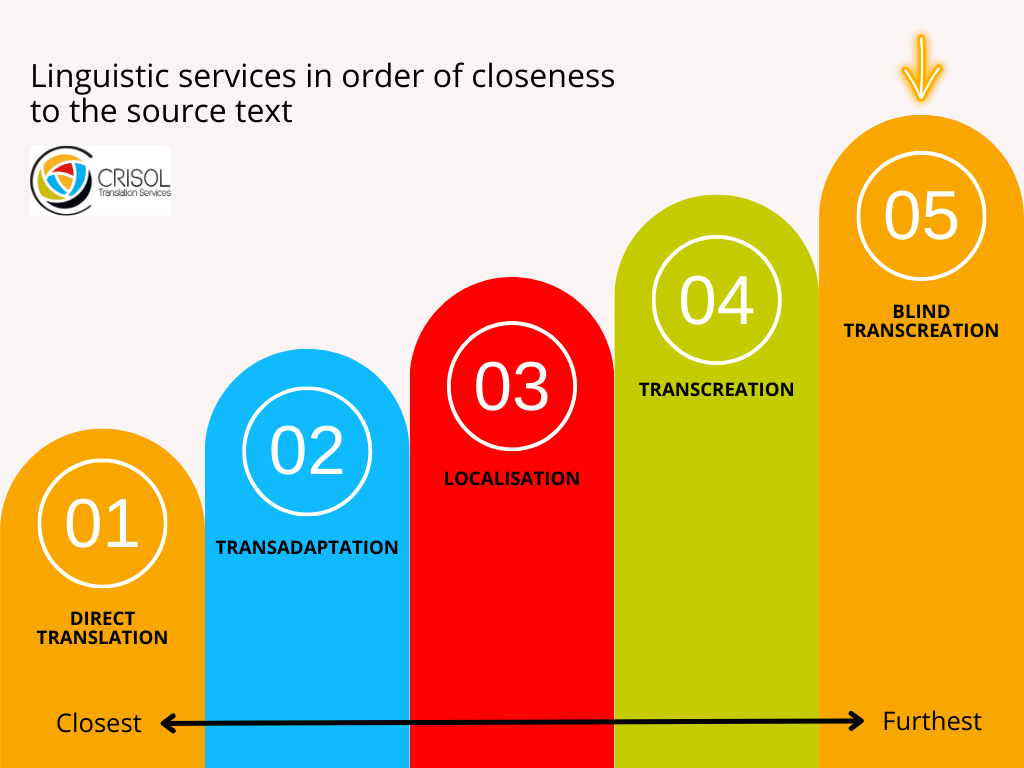
Marketing translation adapts your marketing content for foreign audiences across a spectrum of approaches. At one end, standard translation conveys your message accurately whilst staying close to the original wording. At the other end, transcreation completely reimagines your content to achieve the same emotional impact in a new market, often departing significantly from the source text. Creative translation sits between these two, adapting cultural references and style whilst maintaining the original structure.
Which approach you need depends on your content type and goals:
- Standard translation works for informative content like product descriptions, how-to guides, and technical marketing materials
- Creative translation suits content with cultural references, humour, or idiomatic language that needs adaptation
- Transcreation is essential for emotionally-driven content like slogans, taglines, campaign messaging, and brand positioning
The key question isn’t “Should I translate or transcreate?” but rather “Where does this specific content sit on the spectrum, and how much creative freedom do I need to give the translator?”
In this post:
- What is marketing translation?
- The marketing translation spectrum: understanding your options
- How to choose: decision framework
- Transcreation examples
- Brand consistency across markets: the challenge nobody talks about
- Choosing transcreation providers
- In-house vs agency vs freelance: choosing your model
- Working with marketing translators: how to brief them and what to provide
- How marketing translation is delivered
- The role of AI and machine translation
- Quality control: ensuring your marketing translation works
- Common mistakes (and how to avoid them)
- Mistake: Using the same approach for all content
- Mistake: Providing insufficient context
- Mistake: Expecting transcreation speed at translation pricing
- Mistake: Skipping transcreation for slogans and taglines
- Mistake: Not involving local market experts
- Mistake: Ignoring visual and design adaptation
- Mistake: Translating before validating product-market fit
- Measuring ROI: how to know if marketing translation is working
- Marketing translation vs other related services
- Getting started: a practical roadmap
- Frequently asked questions about transcreation
What is marketing translation?
Marketing translation is the process of adapting marketing content from one language to another so it resonates with audiences who don’t speak your native language. This includes everything from website copy and product descriptions to social media posts, email campaigns, advertisements, and sales collateral.
The term “marketing translation” describes the overarching discipline. Within it, you’ll find different techniques that vary in how closely they stick to the original text versus how much creative freedom they allow.
Think of marketing translation as existing on a spectrum. At one end, you have literal, information-focused translation. At the other, you have complete creative reimagining. Most projects fall somewhere in the middle, and many pieces of content require different approaches for different sections.
A product landing page might need standard translation for specifications and features, creative translation for benefit statements and customer testimonials, and transcreation for the headline and call-to-action.
Why marketing translation matters
Research from CSA Research, which surveyed 8,709 consumers across 29 countries, found that 76% of online shoppers prefer to buy products with information in their native language, whilst 40% will never purchase from websites in other languages. If your marketing content isn’t available in your target audience’s language, you’re losing customers before they even consider your product.
Simple translation often fails for marketing content because marketing aims to persuade, not just inform. A technically accurate translation might convey the facts whilst completely missing the emotional appeal that makes people take action.
Marketing translation done properly doesn’t just make your content understandable in another language. It makes your content persuasive, memorable, and culturally appropriate in ways that drive the same business results you get in your source market.
The marketing translation spectrum: understanding your options
Marketing translation uses different techniques depending on the content type and business goals, forming a spectrum from literal accuracy to creative reimagining.
| Approach | Creative freedom | Stays faithful to | Best for | Typical content |
|---|---|---|---|---|
| Standard translation | Low | Original meaning | Informative content | Product specs, how-to guides, FAQs |
| Creative translation | Medium | Original structure | Content with idioms/cultural refs | Benefit statements, testimonials, blog posts |
| Transcreation | High | Original intent & emotion | Emotionally-driven content | Slogans, taglines, campaign messaging |
| Blind transcreation | Very high | Creative brief only | Short, high-impact messaging | App UI copy, buttons, micro-content |
Standard marketing translation
Standard translation renders your marketing content accurately in the target language whilst staying as close to the original meaning as possible. The translator adapts sentence structure and phrasing to sound natural in the target language, but doesn’t deviate significantly from what you wrote.
This works well when you’re primarily conveying information rather than triggering emotion. Product specifications, feature lists, instructional content, terms and conditions, and straightforward product descriptions all fall into this category.
Even within standard translation, good translators apply some creativity. They might restructure a sentence for clarity, choose between synonyms based on context, or adapt punctuation conventions. The difference is they’re not deliberately reimagining your message for cultural impact.
When to use standard translation:
- Technical product descriptions
- How-to content and tutorials
- FAQs and help documentation
- Pricing information
- Shipping and returns policies
- General informational blog posts
What you get:
- Accurate meaning transfer
- Natural-sounding target language
- Consistent terminology
- Straightforward pricing (typically per word)
What you don’t get:
- Cultural adaptation of references
- Culturally adapted messaging
- Reworked structure for local preferences
Creative translation
Creative translation uses creative methods (humour, metaphors, wordplay) to preserve the essence of your original content whilst adapting it for cultural nuances. Unlike standard translation, creative translators have freedom to adapt cultural references, rework idioms, and adjust tone to feel natural in the target culture.
The key difference from standard translation: creative translators can deviate from your exact wording when doing so better serves the content’s purpose. They’re still working within your structure and staying quite faithful to what you wrote, but they’ll adapt elements that don’t translate well culturally.
Imagine you’ve written “Our software hits a home run for efficiency.” A standard translator working into British English might write “Our software hits a home run for efficiency” (keeping the American baseball reference). A creative translator would adapt it to “Our software scores a try for efficiency” or “Our software knocks it for six” using sports references British readers actually understand.
Creative translation maintains your document structure. If you have five bullet points in the original, you’ll have five bullet points in the translation. If a section is three paragraphs, it stays three paragraphs. The translator isn’t restructuring your content, just adapting the language creatively.
When to use creative translation:
- Marketing website copy
- Brand storytelling content
- Customer testimonials and case studies
- Email marketing campaigns
- Social media posts with cultural references
- Blog posts with idioms or humour
What you get:
- Culturally adapted references and idioms
- Natural-sounding tone and voice
- Strategic use of humour and metaphor
- Structure faithful to the original
What you don’t get:
- Complete message reimagining
- Heavily reworked calls-to-action
- Entirely new concept development
Transcreation
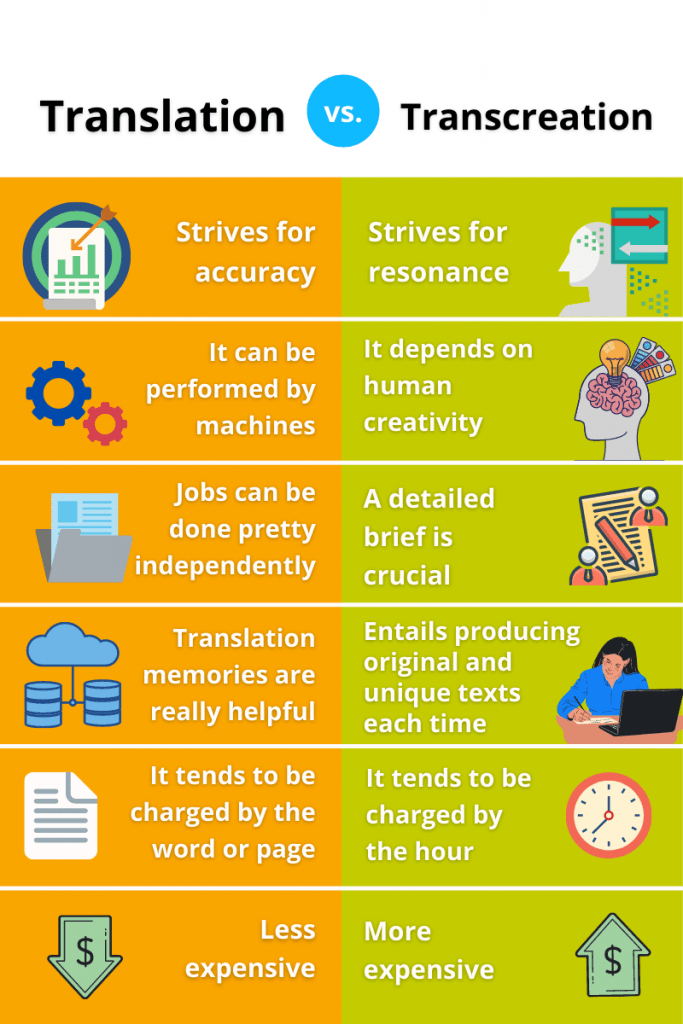
Transcreation is the application of extreme creative translation for marketing and advertising purposes. It is a translation technique – for some experts, a discipline in its own right – concerned with converting international advertising and marketing copy from one language to another, where the focus shifts from the meaning of your source text to its intended impact on the target audience.
Transcreation reaches for resonance rather than equivalence. And by this, we mean brand resonance, defined as how well customers relate to a specific brand; how they perceive the values and goals of that brand. It’s the ability of a brand to create an emotional connection with its consumers. Transcreation seeks to reproduce the aim and effect of your source text in a completely new way deemed natural in the target language and culture.
Transcreators use your source text as a reference point for intent, tone, and style. Then they essentially create new content that will trigger the same emotional response and drive the same action in the target market. The result often looks nothing like a translation when you back-translate it to the source language.
Think of transcreation as multilingual copywriting guided by your original concept rather than translation with added creativity.
When to use transcreation:
- Brand slogans and taglines
- Advertising campaign headlines
- Product and brand naming
- High-visibility marketing campaigns
- Landing page headlines and CTAs
- Video scripts for advertisements
- Packaging copy for consumer products
What you get:
- Content that feels locally created, not translated
- Preserved emotional impact and brand resonance
- Multiple creative options to choose from
- Back-translation and rationale for each option
- Collaboration and feedback rounds
What you don’t get:
- Word-for-word accuracy
- Literal meaning preservation
- Quick turnaround (transcreation takes time)
- Per-word pricing (billed hourly or per project)
Blind transcreation: transcreation without seeing the source
Blind transcreation is transcreation taken to its logical extreme. The transcreator receives a creative brief describing the concept, target audience, desired emotion, and call to action, but they don’t see your source text at all.
This approach emerged from app localisation. Monese, a currency transfer service, had professionally translated button labels and interface text that was technically accurate but still confusing users in various regions. Their localisation manager, Giulia Tarditi, tried giving translators just the function (what should happen when users click this button) without the English text.
The results transformed conversion rates. Without the constraint of English wording, translators created interface text that felt completely natural to local users.
Blind transcreation works when your source text might unconsciously constrain creative thinking. By removing it entirely, you force the transcreator to think from scratch about how someone in that market would naturally express the concept.
When to use blind transcreation:
- App interface copy (buttons, labels, error messages)
- Short, high-impact marketing messages
- Content where the English version doesn’t translate conceptually
- Situations where you want maximum local creativity
What you get:
- Complete creative freedom
- Solutions that might never emerge from translating the source
- Truly local-feeling content
What you sacrifice:
- Consistency across language versions
- Ability to easily compare translations to source
- Brand voice consistency (requires very detailed brief)
Implementing blind transcreation
We tried implementing blind transcreation with some of our clients, and the results have been fantastic. Of course, to be able to try this approach, each client has to first provide their translation team with a style guide, a brand guide, glossaries, and a good brief – the more thorough the documentation they provide, the better.
The documentation should cover the following:
- Target market
- Demographics of the target locale
- Data and statistics from surveys or market research
- Details on key concepts or message
- Desired outcome of the target text
- Chosen presentation (newsletter, landing page, social media post, brochure)
- Preferred method of distribution (how and when the piece will be shared)
- Details regarding intention (how it will be used)
- Ideal word count
- Character limitations if applicable
- Structure (headings, paragraphs, lists)
- Existing taglines or phrases from previous translation or transcreation work
- Calls to action
- Inspiration and examples to imitate
- Files or links to relevant old projects
See below the formatting specifications from a sample brief put together by our client Jimdo. The third column is where the transcreator will enter their blind transcreation output (in this case, in English):

How to choose: decision framework
Most businesses struggle with knowing which approach to use for which content. This framework can help.
Start with your content’s primary goal
Goal: Inform Users need to understand features, specifications, or instructions. → Use standard translation
Goal: Persuade using logic and benefits Users need to understand value propositions, but cultural adaptation matters. → Use creative translation
Goal: Trigger emotion and action Users need to feel something that compels them to act immediately. → Use transcreation or blind transcreation
Consider your content type
| Content type | Typical approach | Why |
|---|---|---|
| Product specifications | Standard | Facts don’t need emotional adaptation |
| Feature descriptions | Standard to creative | Depends on how benefits-focused vs feature-focused |
| How-to guides | Standard | Instructions need accuracy over emotion |
| Customer testimonials | Creative | Need to sound natural, adapt cultural references |
| Case studies | Creative | Story-focused but structure-heavy |
| Blog posts | Standard to creative | Depends on topic and tone |
| Email subject lines | Creative to transcreation | High impact, short, emotion-driven |
| Website headlines | Transcreation | First impression, drives engagement |
| CTAs | Creative to transcreation | Action-focused, emotion matters |
| Slogans/taglines | Transcreation | Define brand, must resonate emotionally |
| Ad campaigns | Transcreation | Designed to trigger specific emotion |
| Social media | Creative to transcreation | Depends on platform and campaign goals |
Evaluate cultural sensitivity
Ask: Does this content include cultural references, idioms, humour, or concepts that might not exist in the target culture?
Low cultural sensitivity (universal concepts, minimal cultural context) → Standard translation likely sufficient
Medium cultural sensitivity (some idioms, cultural references that can be adapted) → Creative translation recommended
High cultural sensitivity (humour, wordplay, culture-specific concepts, emotion-dependent) → Transcreation necessary
Consider your budget and timeline
Tight budget, fast timeline → Standard translation (priced per word, fastest turnaround)
Moderate budget, reasonable timeline → Creative translation (slightly higher per-word rate, moderate timeline)
Flexible budget, quality critical → Transcreation (hourly or project pricing, longest timeline, multiple revision rounds)
Transcreation typically costs several times more than standard translation for the same source word c
Transcreation examples
Now that we’ve established the differences between transcreation and translation, let’s take a look at two solid transcreation examples that hit the nail on the head.
Transcreation example 1: Movie titles
A common example of transcreation is movie titles. These usually change from one country to another (even if they share the language!) as part of marketing ploys or to make them even more impactful.

Transcreation example 2: Taglines
Here’s a random tagline, from a random food brand’s website, that would need transcreation (culinary translation is very rich in this sense): “Tailoring the Spice Route our way”. Imagine this needed transcreation into French.
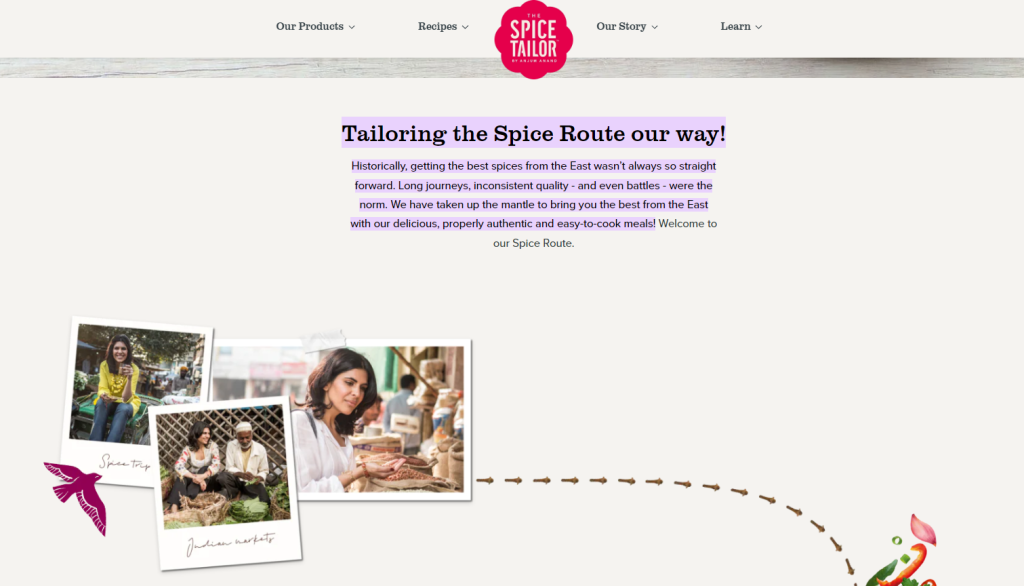
Machine translation would be disastrous here! Instead of “La Route des épices à notre façon !” (direct translation), a good transcreation would be “Découvrez la route des épices à notre sauce !”, which means “Discover the spice route our way” with a play on words with “sauce”.
The French expression “à notre sauce” means “our way” and is particularly well suited here as the brand sells sauces/pastes. It also works with the visuals.
Transcreation example 3: Puns and word plays
Puns and word plays are linguistic gems that often seem impossible to replicate across languages due to language-specific intricacies and cultural contexts. However, it’s important to recognise that not every translated pun automatically falls under the realm of transcreation. Here’s where the distinction between transcreation and creative translation comes into focus.
Transcreation and creative translation may share the goal of adapting creative content across languages, but the intentions and applications diverge: transcreation distinguishes itself by the specific context in which it thrives: marketing and advertising.
Let’s delve into an example that perfectly encapsulates the essence of transcreation: Ryan Gosling donning a jumper that proudly proclaimed, “I am KENough” in the new Barbie movie.

When effectively transcreated, these word plays can become potent tools for international marketing campaigns. For the Spanish-speaking audience, a suitable transcreation could be “Soy sufiKENte.” By seamlessly weaving together “suficiente” (enough) and “Ken,” the transcreated phrase mirrors the original play on words.
What makes this a transcreation? Its real-world impact. The jumper featured in the movie has become an actual product available for purchase, directly linking the transcreation to a marketing endeavor. Furthermore, the scene of Ryan Gosling wearing the jumper has become a meme, amplifying the phrase’s reach and engagement, thereby serving the movie’s marketing campaign.
Brand consistency across markets: the challenge nobody talks about
One of the biggest challenges in marketing translation is maintaining brand consistency whilst allowing for cultural adaptation. Your brand voice, tone, and personality should be recognisable across all markets, but the specific words, references, and style might need to change significantly.
Creating a multilingual brand style guide
A comprehensive brand style guide for multilingual marketing should include:
Core brand attributes (universal):
- Brand personality traits (e.g., friendly, professional, playful, authoritative)
- Values and positioning statements
- What the brand is and isn’t (e.g., “We’re approachable, not complicated”)
- Visual identity guidelines that transfer across markets
Language-specific guidance:
- Tone and formality levels for each language
- Acceptable ways to express brand personality in each culture
- Cultural taboos or sensitive topics to avoid
- Examples of on-brand and off-brand phrasing in each language
Terminology management:
- Key product names and whether they get translated
- Brand-specific terms and their approved translations
- Industry terminology preferences
- Competitors’ names and how to reference them
McDonald’s does this well. Their brand personality (friendly, accessible, family-oriented) stays consistent globally, but expression varies dramatically. In Japan, they lean into kawaii (cute) culture with mascots and playful messaging. In France, they emphasise quality ingredients and café culture. Same brand, different cultural expression.
Building and maintaining translation memories
Translation memory (TM) systems store previously translated segments so translators can reuse them for consistency. When you translate “Free shipping on orders over £50” once, the TM ensures every translator uses the same phrasing in future.
This matters for:
- Product names and features appearing across multiple materials
- Standard calls-to-action used repeatedly
- Legal disclaimers and compliance text
- Brand taglines and messaging
TM systems save money (you don’t pay to translate the same sentence twice) and ensure consistency (your product name doesn’t get translated five different ways across five documents).
Choosing transcreation providers
Selecting a transcreation provider requires different evaluation criteria than choosing translation vendors. You’re not buying commodity language services. You’re buying creative expertise with cultural sensitivity.
Essential qualifications
The transcreator needs cultural immersion in the target market, not just language fluency. Someone who grew up in Germany but moved to the UK fifteen years ago and hasn’t been back might still speak perfect German. They’ve lost touch with how marketing communication has evolved though.
They don’t know current slang, trending topics, political sensitivities, or cultural moments that shape how messages land. They’re working from outdated cultural knowledge that produces transcreation feeling slightly off even if technically correct.
Current cultural engagement matters
Look for transcreators who live in the target market currently or maintain strong ongoing connections through regular work and travel. Ask where they’re based, how often they engage with the target market, what their connection to the local culture looks like, and how they stay current with cultural trends.
Someone actively engaged with the culture produces transcreation that feels current and authentic rather than like someone who learned the language academically but never quite absorbed the culture.
Marketing expertise matters as much as language skill
Marketing and copywriting expertise matters as much as language skill. Transcreation sits between translation and copywriting. The transcreator needs both skill sets working in harmony.
Review samples of transcreated marketing content in their portfolio. Check whether samples demonstrate strategic thinking about audience, messaging, and conversion rather than just clever language play.
Evaluate creative range across different tones and brands to see whether they can adapt or just have one style they apply everywhere. Look for evidence of conversion-focused writing that drives business results rather than just sounding nice.
Subject matter knowledge
Subject matter knowledge in your industry makes significant difference. A transcreator who understands SaaS localisation produces better work for software companies than generalist transcreators.
Someone experienced with culinary translation serves food brands better than transcreators who’ve never thought about how food experiences translate culturally.
Check their previous work in your industry, understanding of industry-specific terminology, familiarity with regulatory requirements if applicable, and knowledge of competitor landscape in target market.
Red flags when hiring
Several warning signs indicate transcreation providers who’ll likely disappoint.
If someone promises to start work immediately without asking extensive questions about brand, audience, objectives, and constraints, they’re approaching it as translation rather than transcreation. Good transcreators need to understand your needs deeply before producing anything.
Defensiveness about feedback represents another red flag. Creative work involves iteration and collaborative refinement. Transcreators who take feedback personally or resist revisions make projects difficult and unpleasant.
Look for collaborative problem-solving attitude where the transcreator works with you to find solutions rather than defending their initial choices stubbornly.
Other warning signs
Not providing back-translation suggests either misunderstanding of transcreation best practices or worry about transparency. Transcreators who resist back-translation either don’t understand why it matters or fear that showing you what they actually wrote will expose problems. Either way it creates risk you don’t need.
Single option delivery indicates limited creative exploration or overconfidence in first drafts. Transcreation projects should present multiple creative approaches so you can choose the direction that best serves your goals.
Transcreators who deliver one version either didn’t explore broadly enough or believe their first instinct is always right. Neither bodes well for creative quality.
Trial projects before major commitments
Before committing to large-scale work with a new transcreator, run a trial project. This reveals how the transcreator approaches briefing and discovery, creative range and strategic thinking, communication style and responsiveness, process discipline and reliability, and collaborative approach to feedback.
Make the trial small enough to minimise risk if results disappoint but representative enough of future work that it tests relevant capabilities. Define clear success criteria so you can evaluate objectively rather than on vague impressions.
Budget appropriately to allow for proper transcreation rather than rushed work that doesn’t show the transcreator’s real capabilities.
Questions to ask during vendor selection
About process, ask them to walk you through their typical transcreation workflow, how many creative options they typically provide, how they handle revisions, and what information they need from you to start.
About expertise, ask what industries they specialise in, whether they can share examples of successful transcreation projects, how they stay current with target market trends, and who reviews their work before client delivery.
About collaboration, ask how they prefer to communicate during projects, what their typical response time looks like, how they handle compressed schedules when necessary, and what happens if you’re not satisfied with initial options.
About pricing, ask how they structure pricing for transcreation, what’s included in their base rate, how they handle revision rounds beyond the initial scope, and what payment terms they offer.
Evaluating their answers
The answers reveal whether the provider understands transcreation properly and whether they’re a good fit for your needs and working style. Someone who can’t articulate their process clearly probably doesn’t have a well-thought-through process.
Someone who can’t explain how they handle revisions probably hasn’t thought through the collaborative aspects of creative work. Pay attention not just to what they say but how they say it.
Do they inspire confidence and demonstrate strategic thinking or do they sound like they’re winging it?
In-house vs agency vs freelance: choosing your model
How you structure your marketing translation operation significantly affects both what you pay and what you get.
In-house translation team
When this works:
- High volume of ongoing content across multiple markets
- Need for extremely tight brand control
- Industry-specific terminology requires deep product knowledge
- Speed matters more than per-project cost
Advantages:
- Translators deeply understand your products and brand
- Faster turnaround (they work only for you)
- Easier collaboration with marketing and product teams
- Better long-term consistency
Challenges:
- High fixed costs (salaries, benefits, training)
- Limited language coverage (hiring for every language is expensive)
- Translators may lack marketing or creative writing background
- Difficulty scaling up or down with fluctuating workloads
Translation agency
When this works:
- Multiple languages needed
- Project-based rather than continuous workflow
- Need for specialised expertise (transcreation, technical, legal)
- Want single point of contact managing all languages
Advantages:
- Access to translators across dozens of languages
- Agency handles project management, quality control, formatting
- Specialised teams for different content types
- Scalable (easy to ramp up or down)
Challenges:
- Higher per-word costs than freelancers
- Less direct control over who works on your content
- Agency overhead and profit margin built into pricing
- May prioritise speed over deep brand understanding
What to look for:
- Specialisation in marketing translation (not just general translation)
- Native speaker translators who live in target markets
- Proven experience in your industry
- Clear quality control processes
- Transparent pricing and timelines
Freelance translators
When this works:
- Specific language pairs with reasonable volumes
- Budget-conscious approach
- Direct relationship with translator matters
- Specialised expertise needed
Advantages:
- Lower costs than agencies
- Direct communication with translator
- Flexibility in rates and timelines
- Can build long-term relationships
Challenges:
- You handle project management and quality control
- Finding reliable specialists takes time
- No backup if your translator is unavailable
- Difficult to scale across many languages
- You need expertise to evaluate translator quality
Finding good freelancers:
- Professional networks (ProZ, TranslatorsCafe, Upwork for vetting only)
- Referrals from other businesses in your industry
- Crisol’s approach of specialist boutique teams
- Portfolio reviews and paid test projects
Hybrid approach (us at Crisol Translation Services!)
Many successful companies use a combination:
- In-house for core markets with highest volumes
- Agency for large, complex projects across many languages
- Vetted freelancers for ongoing smaller projects in specific languages
This balances cost, quality, and flexibility whilst maintaining control over brand-critical content.

Working with marketing translators: how to brief them and what to provide
The quality of your marketing translation depends heavily on the information you provide. Translators need different things for each approach.
For standard translation
Essential:
- Source content in editable format
- Glossary of key terms and preferred translations
- Brand style guide if available
- Context for where this content will appear
Helpful:
- Information about your target audience
- Links to existing translated materials for consistency
- Any terms that should never be translated (brand names, product names)
For creative translation
Everything from standard translation, plus:
- Examples of tone and voice you want to maintain
- Cultural context your source content assumes
- Any cultural references or idioms you’ve used intentionally
- Information about your target market’s cultural preferences
Example brief excerpt: “This email campaign targets German software developers aged 25-40. The tone should feel knowledgeable but approachable, not overly formal. The CTA ‘Join the revolution’ uses ‘revolution’ metaphorically to suggest innovation, not political uprising. Please adapt this metaphor if it doesn’t resonate in German tech culture.”
For transcreation
Everything from creative translation, plus:
- Clear explanation of the emotional response you want to trigger
- The specific action you want readers to take
- Cultural taboos or sensitivities to avoid in the target market
- Budget for multiple creative options and revision rounds
- Examples of competitor messaging in the target market
- Any non-negotiable brand elements that must be preserved
Example brief excerpt: “This tagline needs to convey trust and security for a fintech app targeting risk-averse Japanese consumers. The emotion we want: reassurance and confidence. The action: download the app. Cultural consideration: Japanese banking culture values stability and longevity over innovation. Avoid language that emphasises disruption or rapid change. We need several creative options with rationale for each.”
How marketing translation is delivered
What you receive varies significantly by approach.
Standard translation deliverables
- Translated text in the same format as source
- Glossary of terms used
- Any translator notes on ambiguities or suggestions
Pricing: Per word (typically £0.08-0.15 per word depending on language pair and specialisation)
Timeline: A thousand to two thousand words per day per translator for most language pairs
Creative translation deliverables
- Translated text with cultural adaptations
- Notes explaining significant adaptations
- Suggestions for improvements if the translator identified issues
- Glossary of terms
Pricing: Per word at slightly higher rates (typically £0.12-0.20 per word)
Timeline: One thousand to one thousand five hundred words per day (slower due to creative thinking required)
Transcreation deliverables
- Multiple creative options (typically several per item)
- Back-translation of each option
- Rationale explaining the creative thinking and cultural adaptation
- Collaboration through feedback rounds
- Final selected option polished
Pricing: Hourly (typically £50-100/hour) or project-based
Timeline: Highly variable. A single slogan might take several hours of work. A campaign might take weeks.
The role of AI and machine translation
AI translation tools have improved dramatically. DeepL, Google Translate, and other neural machine translation systems produce surprisingly natural-sounding output for many language pairs. Some businesses use AI-generated translations as a first draft, then have human translators refine them.
Where AI works well
Post-edited machine translation (PEMT) combines AI speed with human quality control. The workflow:
- AI translates the content
- Human translator edits for accuracy, naturalness, and brand voice
- Second reviewer checks quality
This works well for:
- High-volume informational content (product descriptions, FAQs, help articles)
- Content where perfect isn’t required (internal communications, draft materials)
- Tight budgets where some quality trade-off is acceptable
PEMT typically costs 30-50% less than human translation and delivers faster, but quality depends heavily on how much editing is needed.
Where AI fails in marketing translation
AI cannot yet:
- Detect subtle cultural nuances that make content feel off to local readers
- Make strategic creative decisions about emotional resonance
- Understand when a direct translation misses the intended impact
- Adapt brand voice consistently across culturally different contexts
- Handle transcreation (which requires reimagining, not translating)
For creative translation and transcreation, AI might help brainstorm alternatives, but human expertise remains essential. The pattern is clear: AI assists with speed and scale on informational content, but cultural trust and emotional resonance require human translators who understand both language and marketing.
Quality control: ensuring your marketing translation works
Quality control for marketing translation requires different approaches than checking technical translation accuracy.
For standard translation: accuracy and consistency
Use back-translation for high-stakes content by having a different translator convert your target language version back into your source language, which reveals whether meaning has been preserved accurately.
Back-translation works well for:
- Legal marketing disclaimers
- Medical or health-related marketing claims
- Financial services marketing materials
- Anything where regulatory compliance matters
Back-translation doesn’t work well for transcreation because the whole point of transcreation is departing from the source wording. When back-translated, transcreated content often sounds nothing like the original, but that’s expected and correct.
For creative translation and transcreation: resonance and impact
Native speaker review: Have someone from the target market who wasn’t involved in the translation read it cold. Do they understand it immediately? Does it sound like it was written by a local? Does it trigger the intended emotion?
A/B testing: For high-impact content like website headlines, ad copy, or CTAs, test different creative options with real users in the target market. Measure click-through rates, engagement, time on page, conversion rates.
Cultural consultant review: For markets you’re less familiar with, have a cultural consultant review the content specifically for cultural appropriateness, potential misunderstandings, and local resonance.
Common mistakes (and how to avoid them)
Mistake: Using the same approach for all content
Many businesses choose one approach (usually standard translation because it’s cheapest) and apply it to all marketing content, which fails because different content types need different levels of creative freedom.
Fix: Audit your content and categorise by goal and cultural sensitivity. Apply the decision framework to choose the right approach for each piece.
Mistake: Providing insufficient context
Translators working with a product description in isolation, without seeing the product, the target audience, the brand positioning, or the desired action, can’t make good creative decisions.
Fix: Always provide context. Where will this appear? Who’s reading it? What should they do after reading? What’s the brand personality?
Mistake: Expecting transcreation speed at translation pricing
Transcreation takes significantly longer and costs significantly more than standard translation. Businesses sometimes request transcreation whilst budgeting for translation, leading to disappointed expectations on both sides.
Fix: Understand that transcreation is a creative service priced like copywriting, not translation. Budget accordingly.
Mistake: Skipping transcreation for slogans and taglines
Some businesses translate slogans word-for-word because “it’s only five words, how hard can it be?” The result is slogans that sound awkward, miss cultural nuances, or completely fail to resonate emotionally.
Fix: Always transcreate slogans, taglines, and high-visibility campaign messaging. These represent your brand and require emotional resonance, which only transcreation delivers.
Mistake: Not involving local market experts
Translators who don’t live in the target market, haven’t worked in local marketing, or don’t understand local consumer behaviour can’t make informed creative decisions, even if their language skills are excellent.
Fix: Work with translators who are native speakers, live in the target market (or lived there recently), and have marketing expertise in that specific market.
Mistake: Ignoring visual and design adaptation
Marketing isn’t just words. Images, colours, layouts, and design elements carry cultural meaning. A thumbs-up gesture works great in Western markets but is offensive in parts of the Middle East. White represents purity in Western cultures but mourning in many Asian cultures.
Fix: Plan for visual localisation alongside text translation. Work with designers who understand target market preferences.
Mistake: Translating before validating product-market fit
Some businesses translate all their marketing materials into new languages before validating whether their product solves real problems in those markets.
Fix: Start with minimum viable content. Translate enough to test market demand (landing page, basic product description). Only invest in comprehensive marketing translation after you’ve validated that the market wants what you’re selling.
Measuring ROI: how to know if marketing translation is working
Unlike direct response advertising, marketing translation rarely delivers immediate, attributable sales. Instead, measure success through indicators that show whether translated content is resonating with your target audience.
Key metrics to track
Website traffic from target markets Look at organic traffic, direct traffic, and referral traffic from each translated market. Growth indicates your content is discoverable and compelling.
Engagement metrics Time on page, pages per session, and bounce rate show whether users are engaging with translated content. Low engagement suggests the translation exists but isn’t resonating.
Conversion rate by language Compare conversion rates across language versions. If French visitors convert at 2% whilst English converts at 5%, either your French translation isn’t persuasive or you have other market-specific issues (pricing, payment methods, shipping costs).
Customer feedback and satisfaction Survey customers in each market. Ask specifically about website clarity, whether content felt natural, and whether they trusted the brand based on the content.
Support ticket volume and type High volumes of confused support tickets from a specific market suggest your translation isn’t clear enough or doesn’t match user expectations.
Social media engagement Track shares, comments, and reactions on social media content in each language. High engagement suggests content resonates culturally.
Revenue per market Track total revenue, average order value, and customer lifetime value for each language market. Compare these to your investment in translation for that market.
For comprehensive guidance on tracking these metrics, calculating ROI, and benchmarking your performance against industry standards, read our detailed guide on how to measure the ROI of marketing translation.
Marketing translation vs other related services
Marketing translation overlaps with several related services. Understanding the distinctions helps you ask for what you actually need.
Marketing translation vs localisation
Localisation is broader than translation because it includes translating text plus adapting images, colours, date formats, currency symbols, and payment methods, whereas marketing translation focuses specifically on the linguistic and creative adaptation of marketing copy.
A localised e-commerce site needs marketing translation for product descriptions and CTAs, but also localisation for checkout flows, payment options, shipping information, and return policies.
Marketing translation vs SEO translation
SEO translation adapts translated content for search engines in target markets through keyword translation, adjusting content structure for local search behaviour, and implementing technical SEO elements like hreflang tags.
Marketing translation focuses on persuasion and emotional resonance. SEO translation focuses on discoverability and search rankings. Most international websites need both: SEO translation to get found, marketing translation to convert visitors once they arrive.
For a complete guide to optimising translated content for search engines, read our comprehensive guide to SEO translation.
Marketing translation vs copywriting
Copywriting creates original content for a specific market. Marketing translation (especially transcreation) adapts existing content from another market. Both require understanding of persuasive writing and target audience psychology.
Sometimes you need copywriting instead of translation. If your English messaging simply won’t work in the target market (different product-market fit, different pain points, different buyer journey), hire a local copywriter rather than translating English content that won’t resonate.
Getting started: a practical roadmap
Ready to translate your marketing content into new markets? Start with these steps.
Step 1: Audit your content
List all your marketing materials. For each piece, identify:
- Primary goal (inform, persuade, trigger emotion)
- Cultural sensitivity (low, medium, high)
- Business impact (how critical is this to conversion?)
- Current state (exists in source language only, or already translated?)
Step 2: Prioritise by impact
Start with content that has the highest business impact and highest traffic:
- Homepage and key landing pages
- Product descriptions for your top sellers
- Email templates that drive the most revenue
- Ads or campaigns with the largest budget
Don’t try to translate everything at once. Prioritise ruthlessly.
Step 3: Choose your approach for each piece
Apply the decision framework from earlier. Categorise each prioritised piece as needing standard translation, creative translation, or transcreation.
Step 4: Find the right translators
Look for translators who:
- Are native speakers of the target language
- Live in (or recently lived in) the target market
- Have marketing expertise, not just translation skills
- Understand your industry
- Can provide portfolio examples of similar work
Step 5: Create detailed briefs
Even for standard translation, provide context. For transcreation, invest time in comprehensive creative briefs.
Step 6: Build your style guide and terminology
Document your brand voice, terminology preferences, and cultural considerations to create your foundation for consistency.
Step 7: Test and iterate
Launch translated content to a small segment first. Measure engagement and conversion. Gather feedback. Refine based on data before rolling out widely.
Step 8: Establish ongoing processes
Marketing content changes constantly. New campaigns, new products, seasonal messaging, updated positioning. Build translation into your content creation workflow so new content gets translated as part of the standard process, not as an afterthought.
Frequently asked questions about transcreation
What is transcreation? Transcreation is the process of recreating marketing content for a new audience to achieve the same emotional impact as the original, rather than translating it word for word. Where translation asks “what does this say?”, transcreation asks “what is this trying to make the reader feel and do, and how do we make that happen in this market?” The result often looks nothing like the source text when translated back.
What is the difference between translation, creative translation, and transcreation? The three exist on a spectrum. Standard translation stays close to the source wording and structure, which works well for informative content like product descriptions and technical materials. Creative translation adapts cultural references and tone while broadly maintaining the structure of the original. Transcreation starts from the intended emotional impact and the brief rather than from the source words, and may diverge significantly from the original. A product landing page might need all three: standard translation for specifications, creative translation for benefit statements, and transcreation for the headline and call-to-action.
What types of content need transcreation? Slogans, taglines, campaign headlines, advertising copy, and brand positioning statements are the clearest cases. Content that relies on wordplay, cultural references, humour, or idiom that doesn’t transfer directly also needs transcreation. What counts as “needing transcreation” varies by market: some references that travel well between the UK and US will need full recreation for German or Japanese audiences.
What is blind transcreation? Blind transcreation takes the process a step further: the transcreator receives a creative brief describing the concept, target audience, desired emotion, and call to action, but does not see the source text at all. This approach produces content that is entirely free from the gravitational pull of the original wording. It emerged partly from app localisation work, where translated interface copy was technically accurate but still confusing to users because it was shaped by English syntax and assumptions.
How is transcreation quality controlled? Back-translation is not the right tool for transcreation, since the whole point is that the final text will diverge from the source. Native speaker review works well: having someone from the target market read the transcreated content cold and assess whether it immediately makes sense, sounds locally produced, and triggers the intended response. A/B testing on high-stakes content (headlines, CTAs) provides conversion data to settle questions that subjective review cannot.
What should you look for when hiring a transcreator? Current cultural engagement in the target market matters more than general fluency. Someone who grew up in Germany but left 15 years ago and has limited current connection to the market will produce transcreation that feels slightly out of step even if grammatically perfect. Marketing expertise is as important as language skill: transcreators need to understand what they are trying to achieve commercially, not just how to write well. Red flags include starting work without extensive questions about brand, audience, and objectives, and resistance to providing back-translation of the final text for transparency.
We’re Crisol, a specialist team of marketing and SEO translators working primarily with SaaS companies and hospitality brands. We help businesses produce locally persuasive marketing content across markets. You can hire one of us as a freelancer or work with us as a boutique agency. Get in touch to discuss your project.

Author: Maria Scheibengraf
Maria Scheibengraf is an English-to-Spanish marketing and SEO translator specialised in software (SaaS, martech, fintech), and Operations Manager at Crisol Translation Services, which she co-founded in 2016. With a solid background in programming and marketing, Maria has an in-depth understanding of the technical intricacies involved in software programs, websites, and digital platforms. Maria is also the author of The SEO Translation Bible.


4 thoughts on “From Translation to Transcreation: The Marketing Translation Spectrum”
Hi Crisol team, thanks for this insightful article, I appreciated it a lot! I think it‘s an important debate worth having, and myself being a marketing translator for 10 years now, here are my 2 cents in order to add a different perspective.
One issue I have with the term transcreation is that is often defined by devaluing „regular“ translation. In such comparisons – „transcreation vs translation“ -, you often read that translation is done „word by word“ (or very close to the source text), that it doesn‘t involve creative thinking, that it can often be done almost independently from outside context, that machine translation can adequately replace it, and that it basically results in a fixed carbon copy of the original text where the client carries the risk that the translation will ultimately fail to reach the target audience because it is not adapted to their needs. Listening to such descriptions of „regular“ translation, it’s not surprising that translators are often regarded as „word-processing machines“ who can only expect low rates, and not as valuable language consultants on an equal footing. And people might ask why you would even have to study such a “one-dimensional” job for years at university…
I also studied translation for five years and I would argue that all the things that characterize a transcreation mindset are already included in the skillset of a professional translator (apart from of course the content writing/marketing expertise): – You learn to take a strategic approach to EVERY translation. In particular, analyzing the message sender, the target audience, the context and the text‘s purpose (things that are usually included in the creative brief for a transcreation – but in fact they are relevant for every translation (although in reality they are of course sometimes disregarded for time/budget constraints)).
This blog also says that translation strives for equivalence, while transcreation stives for resonance. I would disagree and say that translation also always needs to strive for resonance with the target audience (how could it not?). Equivalence is a well-known concept in translation science, but more recent in this field is the Skopos theory, which focuses on functional appropriateness instead of linguistic equivalence. So modern translation strategies actually place a larger focus on the target text – something that is important in transcreation as well.
Creativity is also constantly needed to some degree in „regular“ translation. Some examples:
– deciding whether a translation should lean towards the source or target culture o deciding whether to keep the ST function or whether a different function is needed o should the text focus on being comprehensible or accurate?
-How to deal with new/unknown concepts/terminology?
– And of course cultural differences etc.
I think the problem of translation is already in its name, meaning to transfer, bringing something from a to B. It conjures up the image of a purely mechanical task – just take a dictionary and transport the source to the target text, while in most cases, there are more complex cognitive processes involved when doing a translation. So, to make a long story short, I would argue that in a more modern (scientific) definition of translation, transcreation is already included – because finding creative solutions, prioritizing the target text purpose over faithfulness to the source text, adapting the source text were necessary to cultural and market requirements are things that are natural to regular translations as well (although I know a lot of translators in reality are unfortunately not confident to go down this route).
The defining factor of transcreation in our industry context is then maybe the marketing/advertising aspect (and maybe a higher “disregard” of the source text). I think the positioning of transcreation as a service is mostly commercially motivated in that it tries to distinguish itself from the „standard“ translation service you get in the industry (300 words per hour, often work for agencies or on very different texts where you cannot really strategically consult with the end client). It‘s a way to position a premium service that redefines the valuable role of the translator. So, by any means, sorry for this small rant! But it’s a topic I am also interested in and where I am always greatful to receive new input. :) Hope you have a great day and greetings from Germany!
Hi! Thanks so much for your comment! Maria replying here. Let me address your comment point by point so I don’t miss anything.
You say: “In general, the issue I have with the term transcreation is that is often defined by devaluing „regular“ translation. In such comparisons „transcreation vs translation“, you often read that translation is done „word by word“ (or very close to the source text), that it doesn‘t involve creative thinking, that it can often be done almost independently from outside context, that machine translation can adequately replace it, and that it basically results in a fixed carbon copy of the original text where the client carries the risk that the translation will ultimately fail to reach the target audience because it is not adapted to their needs.”
I say: My first instinct was to say that I don’t agree that transcreation is often defined by devaluing regular translation and that I, at least, have never seen it defined that way, nor do I use that comparison. But after a quick Google search as kindly suggested by you through our social media, I’m appalled to see you’re unfortunately right about how misunderstood and badly defined the term is. Translation and transcreation are just different *TECHNIQUES*, fit for different purposes, and striving for different outcomes in the process. Depending on what you have at hand (yes, Skopos – I also studied translation for 5 years and they taught us this) is the technique you apply.
I also think it crucial to question and fight the notion of “word for word” translations. They don’t exist. It’s “concept by concept”. That’s why I never speak of “literal” translation but rather “direct” translation.
I further agree with what you say about “translators are often regarded as „word-processing machines“ who can only expect low rates, and not as valuable language consultants on an equal footing.” It’s sad indeed, and here’s a whole new article on the ills of translation industry that relates to that: https://crisolmarketing.com/our-blog/exploitation-in-the-translation-industry/
You say: “All the things that characterize a transcreation mindset are already included in the skillset of a professional translator (apart from of course the content writing/marketing expertise)”.
I say: I don’t agree. Let me break it down below.
1. “You learn to take a strategic approach to EVERY translation.”: True, but that doesn’t mean you learn the confidence and skill to sometimes break away completely from the source text. Or to do it appropriately. Or to suggest it to the client when it doesn’t come in the creative brief. A skilled professional translator is normally trained to transfer meaning between two languages within their area of expertise and according to the instructions of the client, and that’s not equal to understanding about things like what the ideal length of a conversion-favourable CTA is. You need to know about marketing and you need to become your client’s local-language marketing consultant to be a good transcreator.
2. “Translation also always needs to strive for resonance with the target audience”: I think you misunderstood my argument (I shall look into wording it more clearly and even edit the present article). I meant “brand resonance”, defined as “how well clients and customers relate to a specific brand; how they perceive the values and goals of that brand. It’s the ability of a brand to create an emotional connection with its consumers.” Not all translations need to create an emotional connection with its consumers (think: a legal document, a washing machine manual). Emotional connection is, in my view, the most relevant in marketing, sales, and art (I’d originally written “only”, but on social media you provided some examples of other types, such as COVID-19 communications, where emotional connection was crucial, and I agree).
3. “Creativity is also constantly needed to some degree in translation”. Agreed, but that’s precisely why I distinguish “creative translation” from “transcreation”. I define the former as “a form of translation that uses creative methods to accurately communicate the message behind the source text, staying quite faithful to the original while allowing for some creative leeway.” I define the latter – transcreation – as “the application of an extreme form of creative translation for advertising purposes that looks to emulate the tone, style, and intent of the original without necessarily transferring the same concepts or conveying the same message.” And I don’t mean deviating a bit from the message here and there – I mean sometimes completely disregarding it.
4. You define transcreation as “finding creative solutions, prioritizing the target text purpose over faithfulness to the source text, adapting the source text were necessary to cultural and market requirements”: I don’t agree with that definition. That, to me, is creative translation (unless specifically used to raise brand awareness or convert customers).
5. Regular translation, to me, is a direct transfer of meaning – concept by concept, prioritising accuracy without overlooking adequacy. It’s the case of legal, technical, and financial texts, for example. Or straightforward business communications. Or any straightforward content that doesn’t involve highly creative techniques in the source text. Once a considerable degree of creative methods becomes necessary to render a good translation, that’s creative translation. And I’ve already given my 2 cents as to the difference between creative translation and transcreation.
Hi Maria, thanks so much for your detailed and very insightful answer, I appreciate it very much!
Here are some final thoughts to conclude from my side:
To add to the topic of the „underrated“ image of translation in the industry: I think an imprecise definition here and there wouldn‘t be much of a problem. However, I see that many clients also have this view of translation (esp. since the advent of neural MT). And even a considerable number of translators work with this attitude. They don‘t consult much with the client, they don‘t properly analyze the source text, they are not confident to make text adaptions according to cultural or situational requirements (of course, there are often understandable financial reasons for rushing through jobs, resulting in the necessity to produce a high words-per-hour throughput). I would only like to encourage translators to gain a broader view of translation again and have more fun with all the many awesome aspects of the job: to work in-dept with language and cultural subtleties, focus on quality instead of quantity, become a trusted multilingual expert for businesses. Because translators who translate like machines are now being pushed out of the industry or have to work as post editors – I know a few in my surroundings as well.
I also agree with your definition of „creative translation“. I would also like to highlight the difference between finding creative solutions/methods to linguistic problems and employing creative language. Translating a poem, you come up with linguistically creative solutions. However, the translation of a legal text might also require some creativity in regards to language: how do you deal with the Anglo-saxon concept of „tort“ in a German contract? Also, technical translators have to find more creative solutions to translation problems than one might think when it comes to terminology. But of course I absolutely agree that this is still a lot less than transcreation.
Lastly, to the question whether transcreation is something different than translation or should be included within the concept of translation. I can understand both sides. From an academic viewpoint (without being a complete expert in the scientific discourse), my feeling is that many researchers see it rather as a sub-discpipline of translation, not something completely different. See Wikipedia on this topic: „Classically, in a schema dating from the 17th century, translation has been divided into three approaches: metaphrase (word-for-word translation), paraphrase (i.e. “say in other words”), and imitation. Transcreation is thus a variation on the “imitation” or “adaptation” approach to translation. Similarly, viewed in terms of the continuum between free translation and literal translation, transcreation is considered to be “closest to ‘free’ on the literal – free cline. The validity of transcreation as a distinct form of translation, however, has been questioned. While the term has been widely embraced by translation brokers seeking new business, it has been greeted with considerably more skepticism by professional translators.“ In any case, these subtleties in definition are of course not necessarily relevant to how transcreation as a service is perceived and used in our industry.
I absolutely agree with your first paragraph (sadly!) and with the need to establish a difference between finding creative solutions/methods to linguistic problems and employing creative language. In my opinion, it’s only the latter that turns a translation task into creative translation. Thanks so much for your contribution!
Comments are closed.